

A network vulnerability is any weakness in your business's IT systems that an attacker can exploit to gain unauthorized access, steal data, or disrupt operations. Identifying IT vulnerabilities in your business network is the first step toward preventing breaches before they happen. The process combines automated scanning tools, manual reviews, and a standardized risk scoring method to surface security gaps across every connected device and service. This guide gives IT managers and small business owners a clear, repeatable process to detect network security flaws, prioritize fixes, and build lasting cybersecurity resilience.
What tools and prerequisites do you need to identify IT vulnerabilities?
Effective vulnerability identification starts with a complete asset inventory. You cannot protect what you cannot see. Every server, workstation, printer, router, cloud service, and remote access point must be cataloged before any scanning begins. A proper vulnerability assessment covers internal systems, external perimeter, cloud and hybrid environments, and remote access points, replacing assumptions with documented evidence.
Two categories of tools drive the technical side of this work.
| Tool Type | Primary Function | Examples |
|---|---|---|
| Network scanner | Discovers all active devices on the network | Nmap, Angry IP Scanner |
| Vulnerability scanner | Checks for known CVEs, misconfigurations, and patch gaps | Nessus, OpenVAS, Qualys |
| Manual policy review | Evaluates human and procedural controls | Checklists, interviews, config audits |
| CVE database | Reference for known software weaknesses | NIST NVD, MITRE CVE |

Modern vulnerability scanners detect over 17,000 distinct CVEs across current software and hardware. That number means a single unreviewed scan can surface dozens of real exposures on even a small business network. Automated scans alone are not enough. Comprehensive assessments include manual reviews and policy analysis to capture human and process risks that no scanner can flag.
Before running any scan, classify each asset by criticality, ownership, and exposure level. A dental practice's patient records server carries far more risk than a guest Wi-Fi access point. Knowing that difference shapes how you act on findings.
Pro Tip: Build your asset inventory in a spreadsheet first. Include device name, IP address, owner, operating system, and last patch date. This single document will anchor every scan and review you run.
How to conduct a step-by-step vulnerability identification and risk assessment
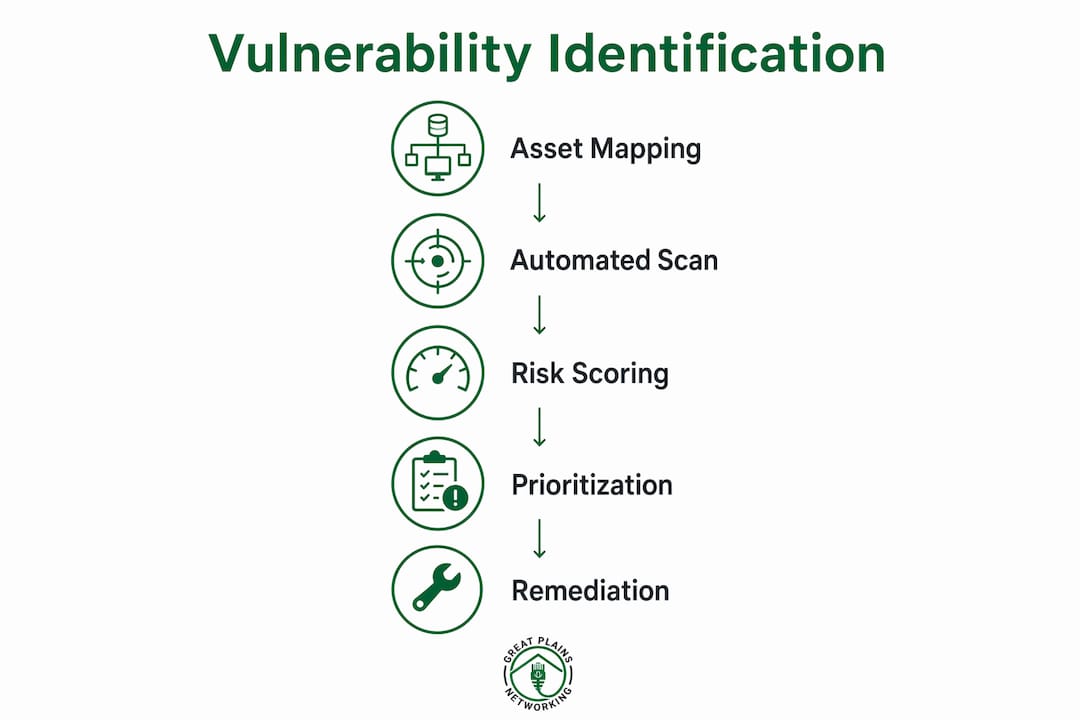
A structured process prevents teams from drowning in scan output without knowing what to fix first. Follow these five steps in order.
-
Map your attack surface. List every asset, user account, cloud service, and remote access method. Include third-party integrations and any device that touches the network, even temporarily.
-
Run automated scans combined with manual verification. Use a vulnerability scanner against your full asset list. Then manually verify the top findings. Scanners produce false positives. A human review confirms which findings are real and exploitable in your specific environment.
-
Score each finding using a standardized risk matrix. Multiply Likelihood (1–5) by Impact (1–5) to produce a risk score from 1–25. A score of 20 or above demands immediate attention. Scores below 6 can be scheduled for routine maintenance cycles.
-
Prioritize remediation by risk score and business impact. A critical vulnerability on a low-value test server ranks below a medium vulnerability on your primary billing system. Business context must inform the order of fixes.
-
Document findings and produce a prioritized remediation plan. Risk scoring must drive actionable remediation plans. A report that sits in a folder has no security value. Tie each finding to a specific owner, deadline, and resolution method.
| Step | Output | Owner |
|---|---|---|
| Asset mapping | Verified asset register | IT manager |
| Automated scan | Raw findings list | Security tool |
| Manual verification | Confirmed vulnerability list | IT analyst |
| Risk scoring | Prioritized risk register | IT manager |
| Remediation plan | Assigned action items | IT manager + leadership |
Pro Tip: Keep your risk scoring simple. A 1–5 scale multiplied by 1–5 gives you enough resolution to make decisions without creating analysis paralysis. Complexity in scoring does not improve security outcomes.
What common network vulnerabilities should businesses watch for?
Small business networks share a predictable set of weaknesses. Knowing the most common ones helps you focus scans and manual reviews where they matter most.
- Unpatched operating systems and third-party software
- Weak or reused passwords across user accounts and network devices
- Misconfigured firewalls with overly permissive inbound rules
- Exposed management ports (RDP, SSH, Telnet) accessible from the internet
- Weak or absent network segmentation between departments
- Outdated firmware on routers, switches, and access points
- Unsecured Wi-Fi networks without WPA3 or proper VLAN separation
- Multi-factor authentication (MFA) gaps on remote access and cloud services
Credential policies, MFA gaps, and remote access misconfigurations are consistent exploit targets. Identity and remote access are now the primary attack surface, not just the network perimeter.
Cloud and hybrid environments add another layer of risk. Misconfigured storage buckets, overly permissive service accounts, and unreviewed API permissions are common in businesses that adopted cloud services quickly without a formal security review.
"Hidden assets like orphaned VPNs, test servers, and shadow IT do not appear on dashboards but create direct pathways for lateral movement inside your network." — Enterprise Vulnerability Assessment: A Practical Guide
Internal network segmentation is often far weaker than business owners believe. Once an attacker gains initial access through a single weak endpoint, poor east-west traffic controls let them move freely across the network. A law firm that segments its client file server from general staff workstations limits that movement significantly. One that does not is fully exposed from a single compromised laptop.
Understanding network security benefits helps frame why segmentation and asset visibility are worth the investment, not just technical checkboxes.
What mistakes should you avoid when managing IT vulnerabilities?
The most common mistake is treating a vulnerability scan as a finished product. A scan produces a list. That list becomes valuable only when it drives decisions about patching, configuration changes, or access controls.
- Relying only on automated scanners. Scanners miss procedural gaps, undocumented admin accounts, and policy failures. Manual reviews are not optional.
- Ignoring control maturity. A strong firewall is ineffective if admin access is undocumented or credentials are never rotated. The most exploitable vulnerabilities are often misconfigured internal rules, not missing hardware.
- Treating the report as the goal. Risk assessment reports are tools. The real goal is a prioritized action plan that defines which risks are accepted, transferred, avoided, or reduced.
- Skipping hidden asset discovery. Personal IoT devices, forgotten cloud resources, and test servers connected to the production network are major threat vectors. They lack visibility and controls, making them easy targets.
- Overcomplicating risk scoring. Teams that build elaborate scoring models often stall on methodology instead of fixing vulnerabilities. A simple, pragmatic scoring approach that directly influences budgeting and response timelines outperforms complex models that nobody uses.
Pro Tip: After every assessment, assign each finding to a named person with a due date. Unassigned findings do not get fixed. Accountability is the most underrated part of vulnerability management.
Reviewing signs your business needs new IT can also reveal systemic gaps that individual scans miss, particularly in aging infrastructure.
How often should businesses perform vulnerability assessments?
Network risk assessments should be conducted at minimum annually or after any significant network change. Significant changes include adding new cloud services, onboarding remote workers, deploying new hardware, or experiencing a security incident.
A practical ongoing security maintenance schedule looks like this:
- Monthly: Review patch status across all systems and devices. Confirm MFA is active on all remote access points.
- Quarterly: Run a full vulnerability scan and compare results against the previous quarter's findings. Track whether remediation items are being closed.
- Annually: Conduct a full business network risk assessment including manual reviews, policy analysis, and attack surface mapping.
- After major changes: Trigger an immediate targeted scan whenever new systems, services, or access methods are added.
Continuous monitoring complements scheduled assessments. Network traffic analysis tools can detect anomalous behavior between formal scan cycles, giving you early warning of active threats. Integrating vulnerability identification with your incident response plan means your team knows exactly what to do when a finding escalates into an active event. Human and procedural controls with documented incident response plans consistently outperform new hardware purchases in real-world security value.
Management involvement matters here. When leadership understands the risk register and approves the remediation budget, fixes actually happen. Vulnerability identification without executive buy-in produces reports, not security.
Key Takeaways
Identifying IT vulnerabilities in a business network requires a repeatable process combining asset inventory, automated scanning, manual review, and risk-scored remediation planning.
| Point | Details |
|---|---|
| Start with asset inventory | You cannot scan what you have not cataloged. Document every device, account, and service first. |
| Use a risk scoring matrix | Multiply Likelihood by Impact on a 1–5 scale to produce a score that drives remediation priority. |
| Include manual reviews | Automated scanners miss procedural gaps, undocumented accounts, and policy failures. |
| Watch for hidden assets | Orphaned devices, shadow IT, and forgotten cloud resources are active threat vectors. |
| Assess at least annually | Run full assessments yearly and after every significant network change to maintain current visibility. |
What I have learned about vulnerability assessments that most guides skip
Most vulnerability assessment guides focus on tools and process steps. The harder lesson is that control maturity determines whether your security posture actually improves after an assessment.
I have seen businesses run thorough scans, produce detailed reports, and then make no meaningful changes because no one owned the remediation items. The assessment became a compliance exercise rather than a security improvement. The fix is not a better scanner. It is accountability and management commitment.
The hidden asset problem is more serious than most small business owners realize. A single personal tablet connected to the office Wi-Fi, a forgotten test server from a vendor engagement, or an old VPN account that was never deprovisioned can give an attacker a foothold that bypasses every perimeter control you have invested in. Visibility is not a technical luxury. It is the foundation of every other security control.
The businesses I see handle this well share one habit: they treat their risk register as a living document, not a quarterly deliverable. They update it when something changes, assign owners to every finding, and review progress in regular team meetings. That discipline, more than any specific tool, is what separates businesses that improve their security from those that just document their weaknesses.
If you are an IT manager or small business owner in Oklahoma, the practical starting point is a full asset inventory followed by a documented risk assessment. Everything else builds from there.
— Nicholas
Greatplainsnetworking helps Oklahoma businesses find and fix network vulnerabilities
Small businesses in Norman, Moore, and Oklahoma City face the same network security risks as larger organizations, often with smaller IT teams to manage them. Greatplainsnetworking provides proactive managed IT support that includes 24/7 monitoring, vulnerability identification, and remediation planning tailored to your specific environment.

Greatplainsnetworking's cybersecurity services cover network scanning, risk assessment, and ongoing monitoring so vulnerabilities are caught before they become breaches. There are no long-term contracts and no technical jargon. Dental practices, law firms, and other small businesses across the Oklahoma City metro rely on Greatplainsnetworking for same-day response and plain-language IT guidance. Contact Greatplainsnetworking to schedule a network assessment and get a clear picture of your current security posture.
FAQ
What does it mean to identify IT vulnerabilities in a business network?
Identifying IT vulnerabilities means scanning and reviewing all networked assets to find security weaknesses, including unpatched software, misconfigured devices, and access control gaps, before attackers can exploit them.
How often should a small business run a vulnerability assessment?
Industry guidance recommends a full assessment at least annually and after any significant network change such as adding cloud services, new hardware, or remote access methods.
What is the best way to prioritize vulnerabilities after a scan?
Use a risk scoring matrix that multiplies Likelihood (1–5) by Impact (1–5) to produce a score from 1–25. Fix the highest-scoring items first, with priority given to assets that carry the greatest business impact.
Why are hidden assets a security risk?
Orphaned devices, forgotten cloud resources, and unmanaged IoT equipment lack visibility and security controls. Attackers use these assets for lateral movement after gaining initial access to the network.
Can automated vulnerability scanners replace manual security reviews?
Automated scanners identify known CVEs and configuration issues but cannot detect procedural gaps, undocumented admin accounts, or policy failures. Manual reviews are required for a complete business network risk assessment.