

Smishing is phishing delivered by text message. Phishing is the broader term: any message that tricks someone into handing over passwords, money or personal data, most often by email. The practical difference for your business is where the message lands. Email filters can screen the inbox, but a text goes straight to a personal phone that no filter on your mail server ever sees. That gap is why a managed security plan has to cover more than email, and it is how we approach it for Oklahoma small businesses at Great Plains Networking.
Key Takeaways
- Smishing (SMS phishing) is one type of phishing. The difference is the delivery channel: text message instead of email.
- Spear phishing is a different axis: it describes how targeted a message is, not how it arrives. A spear phishing attack can come by email or by text.
- Email scanning cannot catch scams sent over SMS or messaging apps, so staff training and multifactor authentication (MFA) carry more weight.
- The safest habit is the same for every channel: never use the link or phone number in the message. Verify through a contact method you already have.
- If someone clicks or replies, speed matters: change passwords, tell the right people internally, and call the bank.
Table of Contents
- Phishing, smishing and vishing: the channel is the difference
- Why smishing works so well on a phone
- Spear phishing: targeted, not a different channel
- Examples your team may actually see
- Warning signs that work on every channel
- Protecting a small business from smishing and phishing
- If someone clicked or replied
- How Great Plains Networking helps
- FAQ
- Sources
Phishing, smishing and vishing: the channel is the difference
Phishing is an attempt to manipulate people into revealing personal or confidential information. It is most common over email, but it also happens through text messages, phone calls, QR codes and social media messages, according to Cloudflare's security reference. The SEC's investor education site puts the distinction plainly: the main difference is the delivery method. Phishing generally uses email, smishing uses text or direct messaging, and vishing uses phone calls.
| Term | Channel | Typical bait |
|---|---|---|
| Phishing | Fake login page, invoice, shared document | |
| Smishing | Text or messaging app | Package notice, bank fraud alert, tax refund |
| Vishing | Phone call or voicemail | "Bank security" or "IT support" caller |
| Spear phishing | Any channel | Message personalized to one person or group |
The goals are the same in every case. Scammers want Social Security, driver's license and passport numbers, bank account numbers, PINs, and usernames and passwords. A text or an email is just the delivery truck.
Why smishing works so well on a phone
People trust their phones, and phones hide the warning signs. Check Point's comparison gives three reasons:
- SMS link-shortening services hide the real destination.
- Mobile devices have no mouseover to reveal where a link goes.
- The always-on phone mentality pushes people to act without thinking.
Brands such as Apple, Amazon and Netflix also use text for urgent account messages, which makes a fake one look normal.
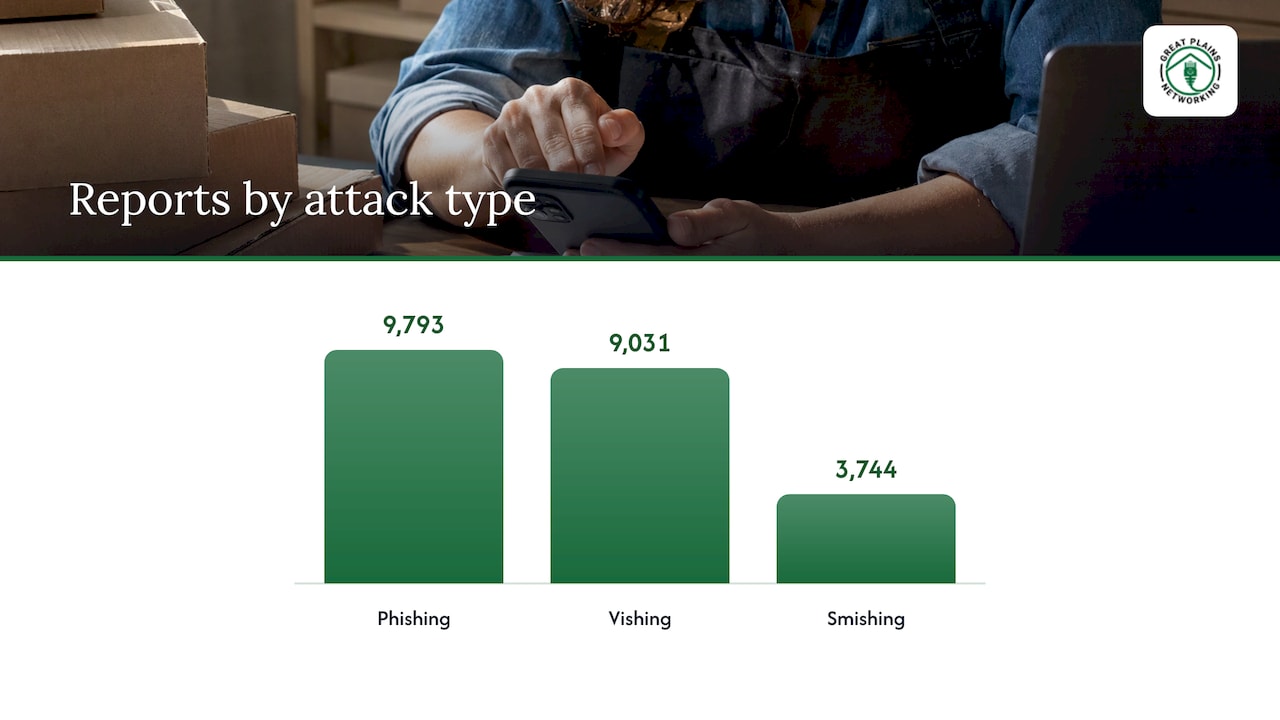
The volume is real too. A June 2024 Better Business Bureau study counted 9,288 phishing-related reports in 2023, a record and more than double the prior year. By type, phishing drew 9,793 reports, vishing 9,031 and smishing 3,744, and smishing has risen every year since 2021. The median loss across all types was $313.
There is also a structural problem for businesses. CISA notes that email scanning cannot catch phishing sent through SMS or messaging apps such as Telegram, Signal, Slack or Teams. If your protection stops at the inbox, a text to an office manager's cell phone walks around it. For a closer look at how email-only tools leave this gap, see this guide to email risk detection.
Spear phishing: targeted, not a different channel
Searches for "phishing vs. spear phishing" are really asking about a second dimension. Ordinary phishing is bulk: impersonal messages from a widely known sender, sent to millions in the hope that a few people bite. Microsoft describes it as a "spray and pray" method with greetings like "Dear customer." Spear phishing is aimed at a specific person or group. It uses details such as job role, location and recent activity, and it appears to come from someone the recipient knows, like a manager or executive.
That targeting is why it is dangerous. IBM reports that spear phishing emails made up just 0.1 percent of all emails in a 12-month period but 66 percent of data breaches in that period.
So the two questions are independent:
- How did it arrive? Email (phishing), text (smishing), call (vishing).
- How targeted is it? Bulk (ordinary phishing) or personalized (spear phishing).
A text that says "Hi Dr. Patel, it's Karen from the front desk, can you approve this vendor payment?" is both smishing and spear phishing.
Examples your team may actually see
Smishing examples
The U.S. Secret Service lists the common patterns:
- Package tracking: a text with a tracking number and a link to a fake site that asks for credentials, personal details or payment.
- Failed delivery: a message saying delivery failed, with a link to reschedule that requests payment information.
- Fraud alert: a notice about a large purchase or suspicious payment, telling you to call a number or click a link.
The BBB study includes a real example: a text claiming to be the Postal Service said two delivery attempts failed because of an insufficient address and asked the recipient to confirm details or the package would be returned. The BBB's advice is to confirm any alert from a business or agency elsewhere before responding.
The FCC adds the bank version and notes the FBI has warned about IRS-themed text scams, where a link leads to a counterfeit site built to harvest personal and financial information.
Spear phishing examples
MIT describes a W-2 spear phishing campaign. An employee who handles financial transactions gets an email that appears to come from his director. It asks him to wire $50,000 and send a copy of an employee's W-2 form. The message uses his name or nickname, but it lacks the director's usual signature and replies go to the scammer.
The BBB documents a similar business case. A small-to-medium St. Louis company wired $70,000 after a compromised vendor's email was used to send fraudulent wire instructions with an invoice. It recovered all but about $7,000 after calling its bank. Its executive now requires written confirmation plus a verbal phone conversation for any vendor request involving electronic funds. Our guide to business email compromise prevention walks through this type of invoice fraud in more detail.
Warning signs that work on every channel
CISA lists signs to look for: sender addresses that imitate a real business by altering or omitting characters, generic greetings and no contact information in the signature, and links whose URL does not match the displayed text. NIST adds requests to download attachments or click links, a sense of urgency, and requests for sensitive information such as bank account or Social Security numbers.
For a front-desk team, that boils down to a short list:
- The message creates urgency or a deadline.
- It asks for money, credentials or personal data.
- It comes from a number or address you do not recognize, or one that is slightly off.
- It asks you to use a link or phone number inside the message.
- It is unexpected, even if it appears to come from a colleague.
The response is the same each time. The U.S. State Department advises checking the originating number and contacting the supposed sender directly using a known number, never a link or number in the message.
Protecting a small business from smishing and phishing
Smishing protection is a layered job. NIST advises small businesses to teach employees to spot and report phishing, keep antivirus software maintained, use email filters and authentication that reject spoofed messages, and enable multifactor authentication, ideally phishing-resistant.
Here is how that maps to a practical routine:
- Turn on MFA everywhere, and move toward phishing-resistant MFA. CISA explains that credential phishing is mitigated primarily by MFA, especially phishing-resistant types such as FIDO. Even if a text tricks someone into typing a password into a fake page, the stolen password alone is not enough. Our post on phishing-resistant MFA covers how to roll it out, and our note on MFA fatigue attacks covers repeated approval prompts.
- Train continuously, not once a year. CISA says annual training isn't enough because threats keep evolving, and recommends that someone, such as an IT provider or staff lead, track emerging threats and share updates. Include texts and messaging apps in the examples, not only email. A 90-day phishing awareness plan gives you a schedule.
- Give everyone a reporting path. Employees should know whom to tell and how, so a suspicious text reaches someone before a second employee gets the same one.
- Require out-of-band verification for money. Any request to change payment details or send a wire gets confirmed by phone, using a number already on file.
- Keep tested backups. If a click does install malware, a clean recovery is what limits the damage. This explanation of protecting backups from ransomware shows why backups need their own protection.
CISA's Bob Lord also cautions against blaming the person who clicked. Organizations should build systems that account for inevitable human error. For a dental practice or law firm, that means layered controls, not hoping nobody ever slips.
If someone clicked or replied
Act quickly and calmly. NIST's guidance for a phished business is to:
- Change the affected passwords right away, along with any reused passwords.
- Contact the fraud department of any financial account involved and watch for unauthorized transactions.
- Notify the appropriate people in the company.
- Notify affected parties if their personal data was compromised, and check your state attorney general's website for breach-notification requirements.
NIST also advises reporting phishing crimes to the FBI's Internet Crime Complaint Center. If money has moved, call your bank first. The St. Louis company above recovered most of its $70,000 because it called its bank.
Regulated practices should treat this seriously. Patient records fall under HIPAA, client files carry confidentiality duties, and nonprofits hold donor data. Our nonprofit cybersecurity checklist lists controls that matter for smaller organizations.
How Great Plains Networking helps
We provide managed IT support for small businesses in Norman, Moore and Oklahoma City, including 24/7 monitoring, cybersecurity with ransomware and phishing protection, and backup and data recovery. We also offer compliance guidance for HIPAA, IRS and CMMC requirements, so dental practices, law firms, accountants, manufacturers and nonprofits get protections that fit their rules. We explain everything in plain language, respond the same day, and do not require long-term contracts.
If you want to know where your business stands against threats like these, start with our 10-minute readiness audit, which is free. You can also see how our managed IT support covers training, MFA and monitoring in one plan.
FAQ
Is smishing the same as phishing?
Smishing is a type of phishing. Phishing is the umbrella term for deceptive messages meant to steal information or money. Smishing is the version delivered by SMS text or direct messaging, while classic phishing generally arrives by email.
What is the difference between phishing and spear phishing?
Phishing is sent in bulk with generic wording, hoping a few people respond. Spear phishing is researched and personalized for a specific person or group, often posing as a coworker, manager or executive. Because it looks relevant, it is far more convincing.
Can smishing target a business, or only individuals?
Businesses are targeted too. Staff phones hold email, banking apps and authenticator codes, and texts that spoof a vendor or executive can lead to credential theft or fraudulent payments. Training and MFA should cover personal and work phones used for work.
How do I report a smishing or phishing attempt?
Tell your internal contact or IT provider first so others can be warned. NIST advises reporting phishing crimes to the FBI's Internet Crime Complaint Center, and you should notify your bank immediately if money or account details were involved.
Sources
- What is smishing? (Cloudflare)
- Don't get "-ished" (SEC Investor.gov)
- Smishing vs. Phishing (Check Point)
- Phishing scams study (Better Business Bureau, June 2024)
- Phishing: What's in a Name? (CISA)
- What Is Spear Phishing? (Microsoft Security)
- Spear Phishing vs. Phishing (IBM)
- Don't be a Victim: Phishing and Smishing (U.S. Secret Service)
- Avoid the Temptation of Smishing Scams (FCC)
- What you should know about Spear-Phishing scams (MIT)
- Avoiding Social Engineering and Phishing Attacks (CISA)
- Phishing (NIST)
- Defending Against Phishing Attacks (U.S. Department of State)
- Teach Employees to Avoid Phishing (CISA)