

Business continuity planning (BCP) is the strategic process that enables organizations to maintain critical operations and protect revenue streams when disruptions strike. Known formally in standards like ISO 22301 and referenced by FEMA's preparedness frameworks, BCP goes well beyond IT recovery. It addresses people, processes, technologies, and third-party dependencies as a unified system. The Business Continuity Institute defines it as the discipline that prepares organizations to respond to and recover from incidents of any scale. Done right, the role of business continuity planning shifts from a compliance checkbox to a genuine competitive advantage.
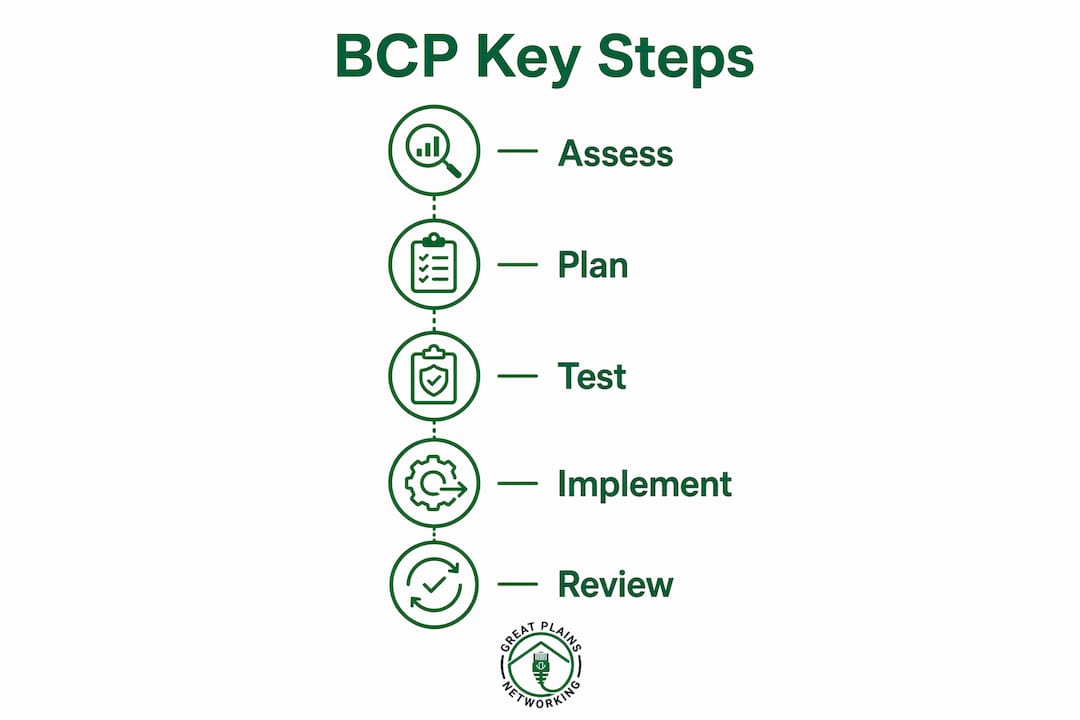
What are the essential components of a business continuity plan?
A business continuity plan has six core phases, each building on the last. Skipping any one of them creates gaps that surface at the worst possible moment.
-
Risk assessment. Identify every credible threat to your operations: cyberattacks, natural disasters, supply chain failures, and power outages. Rank threats by likelihood and potential impact so you allocate resources where they matter most.
-
Business Impact Analysis (BIA). The BIA is the analytical foundation of the entire plan. Plans built without a BIA rely on assumptions that fail during real incidents. The BIA establishes your Recovery Time Objective (RTO), which is how fast you must restore a function, and your Recovery Point Objective (RPO), which is how much data loss is acceptable.
-
Plan development. Assign roles and responsibilities across every department. Document governance structures, escalation paths, and communication protocols. Integrate your disaster recovery procedures here as a subset, not a replacement.
-
Testing. BCP testing should occur at minimum once per year, with multiple exercises recommended. Run tabletop discussions for low-cost scenario walkthroughs, functional drills for department-level practice, and full simulations to test the entire organization under realistic conditions.
-
Maintenance. A plan that sits on a shelf is not a plan. Schedule quarterly reviews to update contact lists, vendor agreements, and recovery procedures as your business evolves.
-
Continuous improvement. After every test or real incident, conduct a formal gap analysis. Document what failed, what slowed recovery, and what needs to change before the next event.
Pro Tip: Run at least one unannounced tabletop exercise per year. Announced tests reveal what people know when they prepare. Unannounced tests reveal what they actually do under pressure.
How does BCP differ from disaster recovery and crisis management?

These three disciplines are related but not interchangeable. Conflating them creates dangerous gaps in your resilience strategy.
| Discipline | Primary Focus | Scope | Key Output |
|---|---|---|---|
| Business Continuity Planning | Maintaining all critical business functions | Entire organization | BCP document with RTOs, RPOs, and roles |
| Disaster Recovery | Restoring IT infrastructure and data | Technology systems | DR runbooks and backup procedures |
| Crisis Management | Leadership response and communications | Executive and stakeholder layer | Crisis communication plan |
BCP is not IT disaster recovery. Disaster recovery is a subset of BCP focused on restoring servers, applications, and data. Crisis management sits above both, coordinating executive decisions and external communications during a major incident. BCP integrates all three disciplines into a single operational outcome: the business keeps running.
A practical example makes this clear. A ransomware attack triggers your disaster recovery team to restore encrypted systems from backup. Your crisis management team notifies customers and regulators. Your BCP governs both responses simultaneously, ensuring customer-facing operations continue through manual workarounds while IT recovers. Without BCP as the coordinating layer, disaster recovery and crisis management operate in silos and slow each other down.
What governance structures drive successful continuity programs?
Clear ownership is the single most reliable predictor of BCP success. Organizations with formal continuity governance recover faster and sustain less damage during incidents. Governance is not bureaucracy. It is the documented answer to "who decides what, and when."
Effective BCP governance requires these roles:
- Business Continuity Manager or Coordinator. This person owns the program day to day. They schedule tests, maintain documentation, track gaps, and report to senior leadership. Without a named owner, plans drift out of date within 12 months.
- Senior Leadership Sponsor. An executive champion secures budget, removes organizational barriers, and signals that continuity is a strategic priority. Programs without executive sponsorship are routinely deprioritized when budgets tighten.
- Cross-functional team. Effective BCP requires collaboration across IT, operations, risk management, communications, HR, and key third-party vendors. Each function owns its recovery procedures and reports into the central governance structure.
- Third-party liaisons. Assign a named contact for every critical vendor. Know their recovery capabilities and contractual obligations before an incident, not during one.
Centralized documentation is equally important. Store your BCP in a location accessible during an outage, whether that is a cloud platform, a printed binder at an offsite location, or both.
Pro Tip: Map your governance structure to your org chart before you write a single recovery procedure. If accountability is unclear on paper, it will be invisible during a crisis.
What are the strategic benefits of continuity planning beyond risk mitigation?
Business continuity planning protects revenue streams and sustains customer trust during disruptions. That is the strategic case, not just the risk management case. Leaders who treat BCP as a growth driver rather than a compliance requirement gain measurable advantages.
The benefits extend well beyond avoiding downtime:
- Revenue protection. A documented plan with tested recovery procedures reduces the financial impact of disruptions. Companies that can restore operations in hours rather than days retain customers who would otherwise defect to competitors.
- Customer trust. Transparent communication during an incident, enabled by a crisis communication protocol embedded in your BCP, signals reliability. Customers remember how you handled a disruption far longer than they remember the disruption itself.
- Competitive positioning. Enterprise clients and regulated industries increasingly require vendors to demonstrate BCP maturity before awarding contracts. A verified, documented plan becomes a sales asset.
- Operational insight. The BIA process forces a rigorous audit of every critical function. Organizations routinely discover inefficiencies, single points of failure, and undocumented dependencies during BIA that they then fix regardless of any disruption.
- Regulatory compliance. Sectors including healthcare, financial services, and legal services face regulatory requirements tied to operational resilience. A mature BCP satisfies multiple compliance frameworks simultaneously.
Leaders who view continuity as a compliance exercise consistently underinvest in it. The organizations that embed BCP into their commercial strategy treat it as proof of reliability, and that proof commands better pricing and stronger client relationships.
How can organizations implement and sustain a continuity program?
Implementation succeeds when it follows a structured sequence. Here is a practical framework for business leaders starting or maturing a continuity program:
-
Conduct the BIA first. Before writing any recovery procedures, complete a thorough Business Impact Analysis. Identify every critical function, quantify the financial and operational impact of losing each one, and set defensible RTO and RPO targets. Review the IT services checklist for 2026 to align your technology dependencies with your BIA findings.
-
Establish governance before writing the plan. Assign your business continuity manager, identify your executive sponsor, and map cross-functional responsibilities. A plan written before governance is in place has no owner and no enforcement mechanism.
-
Address third-party and supply chain risks explicitly. Incomplete BCPs frequently omit SaaS providers, logistics partners, and critical suppliers. For each dependency, document the vendor's recovery capabilities, your contractual protections, and your fallback option if they fail.
-
Build a testing calendar with varied exercise types. Schedule at minimum one full test per year. Add tabletop exercises quarterly. Treating testing as a compliance checkbox undermines readiness. Varied, frequent testing builds the muscle memory your team needs to act decisively under pressure.
-
Integrate backup and recovery technology. Your BCP is only as strong as your data recovery capabilities. Review your business data backup practices to confirm your RPO targets are technically achievable with your current backup infrastructure.
-
Refresh the BIA and plan annually. Business conditions change. New products, new vendors, new staff, and new threats all invalidate assumptions in your existing plan. Schedule a formal annual review tied to your fiscal year planning cycle.
Key takeaways
Business continuity planning is the operational and strategic foundation that determines whether your organization survives and recovers from disruptions, or loses revenue, customers, and credibility in the process.
| Point | Details |
|---|---|
| BIA comes first | Complete a Business Impact Analysis before writing any recovery procedures to set reliable RTO and RPO targets. |
| BCP is broader than IT recovery | Disaster recovery is a subset of BCP; the full plan covers people, processes, communications, and third parties. |
| Governance drives execution | Assign a named business continuity manager and executive sponsor before the plan is written. |
| Testing must be varied and frequent | Run tabletop, functional, and simulation exercises throughout the year, not just one annual review. |
| BCP protects revenue and trust | Organizations with verified plans retain customers and win contracts that competitors without plans cannot. |
Why I think most organizations are still getting BCP backwards
Most business leaders I work with treat the plan document as the deliverable. They spend months writing procedures, then file the document and consider the job done. The document is not the deliverable. Tested, verified readiness is the deliverable.
The BIA is where the real work happens, and it is consistently rushed or skipped. When a plan is built on assumptions rather than evidence, it fails at the exact moment it is needed most. I have seen organizations discover during a real incident that their "critical" systems had RTOs of four hours but their actual recovery capability was 48 hours. That gap existed because no one ran the numbers before writing the plan.
Supply chain risk is the other consistent blind spot. Most small and mid-sized businesses list their internal systems in their BCP but never document what happens if their cloud accounting platform goes down, their logistics provider fails, or their internet service provider has a regional outage. Those are the disruptions that actually happen.
The organizations that get BCP right treat it as a living program, not a document. They test it, argue about it, update it after every near-miss, and hold leadership accountable for its quality. That discipline is what separates organizations that recover in hours from those that recover in weeks. The network security benefits of a proactive IT posture feed directly into that readiness.
— Nicholas
How Greatplainsnetworking supports your continuity program
Building a resilient business continuity program requires more than a document. It requires verified backup infrastructure, proactive network monitoring, and cybersecurity controls that reduce the likelihood of disruptions in the first place.

Greatplainsnetworking provides managed IT support for small businesses in Norman, Moore, and Oklahoma City, with 24/7 monitoring that identifies and resolves issues before they become outages. From cybersecurity services that reduce ransomware exposure to backup and recovery solutions aligned with your RTO and RPO targets, Greatplainsnetworking translates continuity strategy into practical, tested infrastructure. No long-term contracts. Same-day response. Plain language, no jargon. Contact Greatplainsnetworking to assess your current continuity posture.
FAQ
What is the role of business continuity planning?
Business continuity planning maintains critical business functions during disruptions by documenting recovery procedures, assigning roles, and setting measurable recovery targets. It covers people, processes, technology, and third-party dependencies as a unified system.
How often should a business continuity plan be tested?
Plans should be tested at minimum once per year, with multiple exercises recommended including tabletop discussions, functional drills, and full simulations to build team readiness and reveal gaps.
What is the difference between BCP and disaster recovery?
Disaster recovery focuses on restoring IT systems and data after an incident. Business continuity planning is broader, covering all critical business functions including people, communications, and operations, with disaster recovery as one component within it.
Why is a Business Impact Analysis important?
The BIA establishes your RTO and RPO targets based on evidence rather than assumptions. Plans written without a BIA routinely fail during real incidents because recovery capabilities do not match the targets written into the plan.
What are the biggest gaps in most business continuity plans?
The two most common gaps are missing third-party and supply chain dependencies, and insufficient testing frequency. Incomplete BCPs frequently omit SaaS providers and logistics partners, leaving organizations without fallback options when those vendors fail.