

A law firm security policy is a formal, written document that defines the rules, procedures, and technical controls a firm uses to protect client data, attorney-client privileged communications, and internal systems from cybersecurity threats. At its core, the policy covers five interconnected domains: an overall security and awareness program, data classification and handling procedures, access control frameworks such as role-based access control (RBAC), network and asset monitoring, and technology resource security including device management, encryption, and incident response. These elements work together to create a defensible, documented security posture.
Key components every law firm security policy should address:
- Data classification: Categorize data by sensitivity (e.g., privileged communications, PII, financial records) and define handling rules for each tier.
- Access control: Restrict data access to staff with a documented need to know, enforced through RBAC and multi-factor authentication (MFA).
- Network and asset monitoring: Log activity, track sessions, and monitor endpoints continuously.
- Technology and device security: Cover firm-issued and personal devices (BYOD), encryption standards, and secure communication tools.
- Incident response: Define breach detection, containment, investigation, and client notification steps.
- Regulatory alignment: Policies must conform to ABA Model Rules, HIPAA where health-related data is handled, and applicable state laws such as the CCPA or the New York SHIELD Act.
A policy that checks these boxes does more than satisfy a bar association audit. It builds the documented foundation that protects the firm if a breach leads to a malpractice claim or a bar complaint.
Table of Contents
- Why cybersecurity is a legal and ethical obligation for law firms
- What cybersecurity threats are law firms actually facing?
- Best practices for protecting law firm data and infrastructure
- How to create an effective law firm cybersecurity policy
- How to secure cloud services and legal software in your firm
- Expert perspective: what makes a security policy actually defensible
- Key Takeaways
- Greatplainsnetworking can help your firm build and maintain a real security posture
Why cybersecurity is a legal and ethical obligation for law firms
Law firms hold some of the most sensitive data in existence: trade secrets, litigation strategy, financial disclosures, and personal information clients share under the expectation of absolute confidentiality. That combination makes firms high-value cybercrime targets regardless of size. A solo practitioner in Norman, Oklahoma carries the same ethical obligations as an AmLaw 100 firm.
ABA Model Rule 1.6(c) requires lawyers to make reasonable efforts to prevent unauthorized disclosure of client information. ABA Rule 5.3 extends that obligation further: supervising attorneys must ensure non-lawyer staff comply with the firm's security policies, not just the attorneys themselves. Ignoring that requirement creates direct disciplinary exposure.
The consequences of a breach go well beyond a bar complaint:
- Reputational damage: Clients whose privileged communications are exposed rarely return, and word travels fast in legal communities.
- Malpractice liability: A breach caused by inadequate security controls can support a negligence claim.
- Regulatory penalties: Firms handling health-related client data face HIPAA enforcement; those with California clients must account for CCPA obligations.
- Client notification duties: Under ABA Formal Opinion 483, a firm must notify clients when material confidential information is compromised or reasonably suspected compromised.
The ethical standard is not perfection. ABA guidance is clear that Rule 1.6 is not violated simply because a breach occurs, provided the firm made reasonable efforts to prevent it. A documented, enforced security policy is the primary evidence of those reasonable efforts.
What cybersecurity threats are law firms actually facing?
The threat environment for law firms in 2026 is well-documented. Phishing, ransomware, insider threats, and unsecured remote connections remain the four most common attack vectors, and layered defenses are the only reliable response.
- Phishing and social engineering: Attackers impersonate clients, courts, or opposing counsel to trick staff into clicking malicious links or surrendering credentials. A single successful phish can compromise an entire matter file.
- Ransomware: Malware encrypts firm data and demands payment for decryption. Even when no data is exfiltrated, a ransomware event can halt operations for days and trigger client notification obligations depending on what was inaccessible.
- Weak or stolen credentials: Reused passwords and accounts without MFA are the most common entry point for unauthorized access. Using passwords shorter than recommended lengths significantly increases brute-force risk.
- Insider threats: Negligent staff who email sensitive documents to personal accounts, or disgruntled employees with broad access permissions, represent a threat that technical controls alone cannot fully address.
- Remote work and unsecured endpoints: Staff connecting from home networks or personal devices without VPN protection expose firm data to interception. Remote work introduces specific vulnerabilities that a policy must address explicitly.
- Insufficient backup and recovery: Firms without tested, verified backup systems face permanent data loss after a ransomware attack or hardware failure. Recovery time objectives (RTO) and recovery point objectives (RPO) should be defined in writing.
Understanding these vectors is not academic. Each one maps directly to a policy control that either exists in your firm or does not.
Best practices for protecting law firm data and infrastructure
Strong security does not come from a single tool or a single rule. It comes from layered, enforced controls that address people, processes, and technology simultaneously.
- Role-based access control: Assign permissions based on job function. A paralegal working on a real estate matter has no business accessing litigation files. RBAC limits the blast radius of any single compromised account.
- MFA everywhere: Multi-factor authentication on email, case management software, and remote access tools is the single highest-return security control available. It stops the vast majority of credential-based attacks cold.
- Password length over complexity: Modern password standards prioritize a minimum of 12 characters over arbitrary complexity rules. Enforce this through admin console settings, not just policy documents.
- Encryption in transit and at rest: All client data stored on firm servers or cloud platforms must be encrypted. Sensitive communications must never travel over standard email; use encrypted client portals instead.
- Secure client portals: Platforms built for legal practice that include activity logging, session tracking, and MFA are the correct channel for sharing documents and communicating about active matters. Standard email is not.
- Regular employee training: ABA Rule 5.3 requires supervising attorneys to ensure staff compliance. Mandatory, recurring phishing awareness training is the practical mechanism for meeting that obligation.
- Physical security: Clean desk policies, locked workstations, and visitor access controls prevent data exposure from physical means. Screen privacy filters on monitors in shared spaces are a simple, overlooked control.
- Incident response planning: A written plan that defines who does what in the first 24 hours after a suspected breach is worth more than any amount of after-the-fact scrambling. Include breach investigation steps, containment procedures, and the client notification threshold per ABA Formal Opinion 483.
- Regular security audits: Policies that are written once and never reviewed become liabilities. Scheduled audits, at minimum annually, keep controls current with evolving threats and technology changes.
Pro Tip: Network monitoring is a force multiplier for all of these controls. Continuous network activity monitoring catches anomalous behavior, such as a staff account accessing files at 2 AM, that no static policy document can detect on its own.
How to create an effective law firm cybersecurity policy
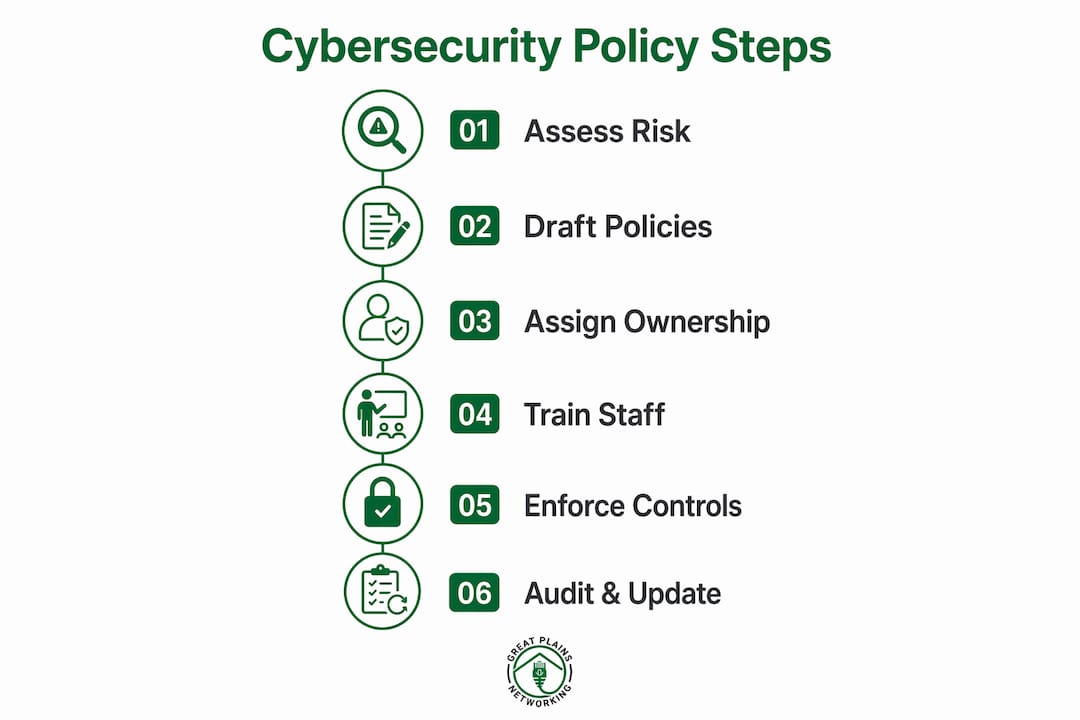
Building a policy from scratch feels daunting, but the process follows a logical sequence. The goal is a document that is specific enough to be enforced and flexible enough to evolve.
Step 1: Assess your firm's actual risk profile. Identify what data you hold, where it lives, who can access it, and what systems connect to the internet. A family law firm handling custody disputes has different exposure than a corporate transactional practice. Your policy must reflect your actual environment.

Step 2: Draft policies across the five core domains. Cover data handling and classification, access control, network monitoring, technology and device security, and incident response. Each section should define the rule, the technical control that enforces it, and the consequence for non-compliance.
Step 3: Assign ownership. Someone must own the policy: review it, update it, and answer for it. In a small firm, that may be a managing partner. In a larger firm, a dedicated IT manager or outside managed IT provider carries that role.
Step 4: Train every person in the firm. Training is not a one-time onboarding checkbox. Threats evolve, staff turn over, and complacency sets in. Quarterly phishing simulations and annual policy reviews with mandatory sign-off are the standard.
Step 5: Enforce through technical controls. A policy that says "use strong passwords" but does not enforce minimum length through the admin console is not a policy. It is a suggestion. Unenforced policies create malpractice liability because they document a standard the firm demonstrably failed to meet.
Step 6: Build in an audit and update cycle. Schedule a formal policy review at least once per year, and trigger an immediate review after any security incident or significant technology change.
Pro Tip: Generic, one-size-fits-all policies fail because they do not account for your firm's specific practice areas, data types, or operational structure. A policy written for a 50-attorney firm with a dedicated IT department is not appropriate for a three-attorney boutique. Tailor every section to your actual environment.
How to secure cloud services and legal software in your firm
Cloud-based practice management platforms, document storage, and communication tools have become standard in legal practice. They introduce real security considerations that belong explicitly in your firm's policy.
- Vet every provider before adoption: Legal software vendors should offer role-based permissions, activity logging, MFA enforcement, and data encryption as baseline features, not optional add-ons. Ask vendors directly about their SOC 2 compliance status and data residency practices.
- Enforce secure configurations: Default cloud settings are rarely the most secure settings. Disable unnecessary sharing features, restrict external access, and require MFA for every account with access to client data.
- Use encrypted client portals: ABA guidance is clear that firms must implement encrypted portals for sensitive communications. Standard email, even with TLS, does not provide sufficient protection for privileged client communications.
- Define remote work standards in writing: VPN use on non-firm networks, prohibition on public Wi-Fi for client work, and device encryption requirements for any machine accessing firm systems must all be documented and enforced.
- Review your cloud posture regularly: Cloud environments change. New integrations, new user accounts, and new features can introduce vulnerabilities that did not exist at initial setup. A scheduled quarterly review of cloud configurations is a practical minimum.
- Understand shared responsibility: Cloud providers secure the infrastructure; the firm is responsible for securing its data within that infrastructure. That distinction matters when something goes wrong. Knowing where your provider's responsibility ends and yours begins is a prerequisite for any cloud security policy.
You can also conduct regular security audits to verify that your cloud configurations and access controls remain aligned with your written policy as your technology stack evolves.
Expert perspective: what makes a security policy actually defensible
A written policy is necessary but not sufficient. The difference between a policy that protects the firm and one that creates liability often comes down to three factors: technical enforcement, documented maintenance, and supervisory accountability.
ABA Model Rules 5.1 and 5.3 place the obligation for compliance squarely on supervising attorneys. The ABA's Formal Opinion 483 framework reinforces this: lawyers must employ reasonable efforts to monitor technology and office resources connected to the internet, and must be able to demonstrate that employees are adhering to the firm's cybersecurity procedures. A policy document that no one enforces does not satisfy that standard.
Key expert-level considerations:
- Living document requirement: Security policies must be treated as living documents, updated as threats evolve, technology changes, and the firm's practice areas shift. A policy last reviewed in 2022 is not a current policy.
- Technical enforcement over paper compliance: Password policies enforced through admin console settings, MFA enforced at the application level, and device management tools that verify encryption status are the controls that actually prevent breaches. Paper policies that rely entirely on staff self-compliance are a documented liability.
- Breach notification nuance: ABA Formal Opinion 483 does not require notification after every security incident. A ransomware attack that encrypted files briefly but did not expose or exfiltrate client data may not trigger the notification duty. The threshold is whether material client confidential information was actually or reasonably suspected to have been accessed, disclosed, or lost.
- Documentation for legal defensibility: In a malpractice claim or bar complaint, the firm's documented security policy, training records, and audit logs are the primary evidence that reasonable efforts were made. Firms without that documentation have no defense.
- Cybersecurity insurance alignment: Your cybersecurity insurance policy terms often require specific technical controls to be in place. A security policy that does not align with your coverage requirements can void a claim at the worst possible moment.
The ABA's standard for "reasonable" security is not a checklist. It is a process: assess risks, implement appropriate controls, verify they work, and update them continuously. A firm that follows that process and documents it is in a fundamentally different position than one that does not.
Key Takeaways
A law firm security policy is only as strong as its technical enforcement, documented maintenance, and supervisory accountability across every person in the firm.
| Point | Details |
|---|---|
| Policy scope | Cover data classification, access control, network monitoring, device security, and incident response in every written policy. |
| ABA obligations | Rules 1.6, 5.1, and 5.3 require reasonable efforts to protect client data and supervise all staff compliance. |
| Technical enforcement | Enforce password minimums (12+ characters) and MFA through admin settings, not policy documents alone. |
| Breach notification threshold | ABA Formal Opinion 483 requires client notification only when material confidential information is compromised or reasonably suspected compromised. |
| Living document standard | Review and update the policy at minimum annually, and immediately after any security incident or major technology change. |
Greatplainsnetworking can help your firm build and maintain a real security posture

For law firms in Norman, Moore, and Oklahoma City, Greatplainsnetworking provides managed IT support built specifically for small businesses that cannot afford a full-time IT department but cannot afford a breach either. The team handles 24/7 monitoring, MFA deployment, encrypted backup, and policy documentation in plain language, with same-day response and no long-term contracts.
If your firm's security policy is a document that lives in a drawer, or if you do not have one at all, Greatplainsnetworking's cybersecurity services give you the technical enforcement layer that turns a written policy into a working defense. Reach out to start with a straightforward assessment of where your firm stands today.