

A staffing firm is a company that recruits, screens, and places workers with client businesses, often serving as the employer of record for temporary and contract assignments. That distinction drives almost everything else in this guide.
- Employer of record: the agency handles payroll, tax withholding, and workers' comp for temp and contract workers
- Main service lines: temporary staffing, contract, contract-to-hire, and direct hire
- Who pays: the client business pays the agency, not the candidate
- Fee types: hourly markups on temp bill rates, flat or percentage fees on direct-hire placements
Here's how the model actually functions, and what it means for whether you're hiring or job hunting.
Key Takeaways
The staffing model works because the agency absorbs payroll and compliance risk in exchange for a markup or placement fee, freeing the client to focus on managing the work itself.
| Point | Details |
|---|---|
| Employer of record | For temp and contract roles, the agency runs payroll, tax withholding, and workers' comp, not the client. |
| Match service to certainty | Use temp or contract for uncertain demand; use direct hire when the need is confirmed and long-term. |
| Fees always fall on employers | Markups on bill rates or direct-hire placement fees are paid by the client business, never the candidate. |
| Define conversion terms early | Set contract-to-hire timelines and success metrics before the trial period starts to avoid disputes. |
| Verify agency capability | Confirm insurance, references, and back-office depth before signing with any staffing partner. |
If your business is weighing staffing flexibility against long-term technology needs, Greatplainsnetworking's managed IT support offers a similar no-long-term-contract model built for small businesses in Norman, Moore, and Oklahoma City.
Table of Contents
- What Is a Staffing Firm's Business Model?
- Types of Staffing Services and When to Use Each
- Why Employers Turn to Staffing Firms
- What Job Seekers Should Know About Staffing Firms
- How Much Do Staffing Firms Charge?
- How the Staffing Process Works Step by Step
- Staffing Firm vs. Recruiter vs. In-House HR
- How to Choose the Right Staffing Firm
- Temporary Staffing or Contract-to-Hire: Which Fits Your Situation?
- Staffing Decisions Are Risk Decisions
- Frequently Asked Questions
- Sources
What Is a Staffing Firm's Business Model?
A staffing firm works as a middleman with legal weight behind it. For temporary and contract placements, the agency is the employer of record, which means it runs payroll, withholds taxes, carries workers' compensation insurance, and manages benefits eligibility. The client company directs the day-to-day work, assigns tasks, and sets the schedule, but the paycheck and the legal employment relationship sit with the agency. The American Staffing Association confirms this split: staffing firms are responsible for wages, tax remittance, and compliance for the workers they assign, even though those workers report to someone else's office.
Recruiters source candidates, screen resumes, run interviews, and present a shortlist to the client, who makes the final hiring call in most arrangements.
- Agency handles: sourcing, screening, payroll, tax filings, workers' comp
- Client handles: supervision, training, day-to-day assignments
- Revenue comes from a markup on the hourly bill rate for temp workers, or a placement fee (often a percentage of first-year salary) for direct hires
A firm placing a temp receptionist at a certain hourly wage might bill the client a higher amount, with the spread covering payroll taxes, insurance, and the agency's margin.
Types of Staffing Services and When to Use Each
Not every hiring need calls for the same arrangement, and the four main service types differ in who employs the worker, how fast you can fill a role, and how much long-term commitment you're taking on.
- Temporary staffing: the agency is the employer of record; fastest option; best for seasonal spikes, sick leave coverage, or short projects with no guarantee of ongoing work
- Contract staffing: similar to temp but usually tied to a defined project or timeline; agency remains employer of record throughout
- Contract-to-hire (temp-to-hire): starts under the agency as employer of record, typically for a trial window of three to six months, then converts to the client's payroll if both sides agree
- Direct hire: the agency recruits and screens, but the client is the employer from day one; slower process, higher upfront fee, no trial period
- Executive search: a specialized form of direct hire for senior or hard-to-fill leadership roles, usually retained with a longer search timeline
Speed and risk move in opposite directions here. Temp staffing fills a seat in days but offers no long-term commitment; direct hire takes weeks longer but gives you a permanent employee immediately.
Pro Tip: If you're not sure how long you'll need the role filled, start with contract-to-hire. It gives you a working trial period without committing to a permanent salary before you know the fit is right.

Why Employers Turn to Staffing Firms
Speed is the biggest draw. A staffing firm can often fill a role faster than an internal recruiting process, especially when you need someone this week, not next quarter.
- Faster time-to-fill than most internal hiring pipelines
- Access to passive candidates who aren't actively job hunting on public boards
- Payroll, tax withholding, and workers' comp compliance handled off your plate
- Flexibility to scale a workforce up or down without permanent headcount commitments
Staffing firms tend to outperform internal recruiting during seasonal peaks, short-term projects, and sudden coverage gaps, exactly the situations where speed matters more than a perfectly tailored long search.
What Job Seekers Should Know About Staffing Firms
Working with a staffing agency costs candidates nothing. The client business pays the fee, never the worker, and any agency asking you for money upfront is a red flag.
- Access to unadvertised openings that never hit public job boards
- Faster placement than applying cold to dozens of companies
- Resume coaching and interview prep from recruiters who know the client's expectations
- A trial period through temp-to-hire that can convert into a permanent role
Because the staffing firm is your employer of record during a temp or contract assignment, it issues your paycheck and handles your tax withholding, even though you report to the client's office.
Pro Tip: Be upfront with your recruiter about salary floors and deal breakers early. Recruiters place people faster when they aren't guessing at what will make you say no.
How Much Do Staffing Firms Charge?
Staffing firms make money two ways: a markup on the hourly bill rate for temporary workers, and a placement fee for direct hires. The markup typically covers payroll taxes, workers' comp premiums, benefits administration, and overhead before the agency takes its margin, which is why bill rates run noticeably higher than what the worker actually takes home.
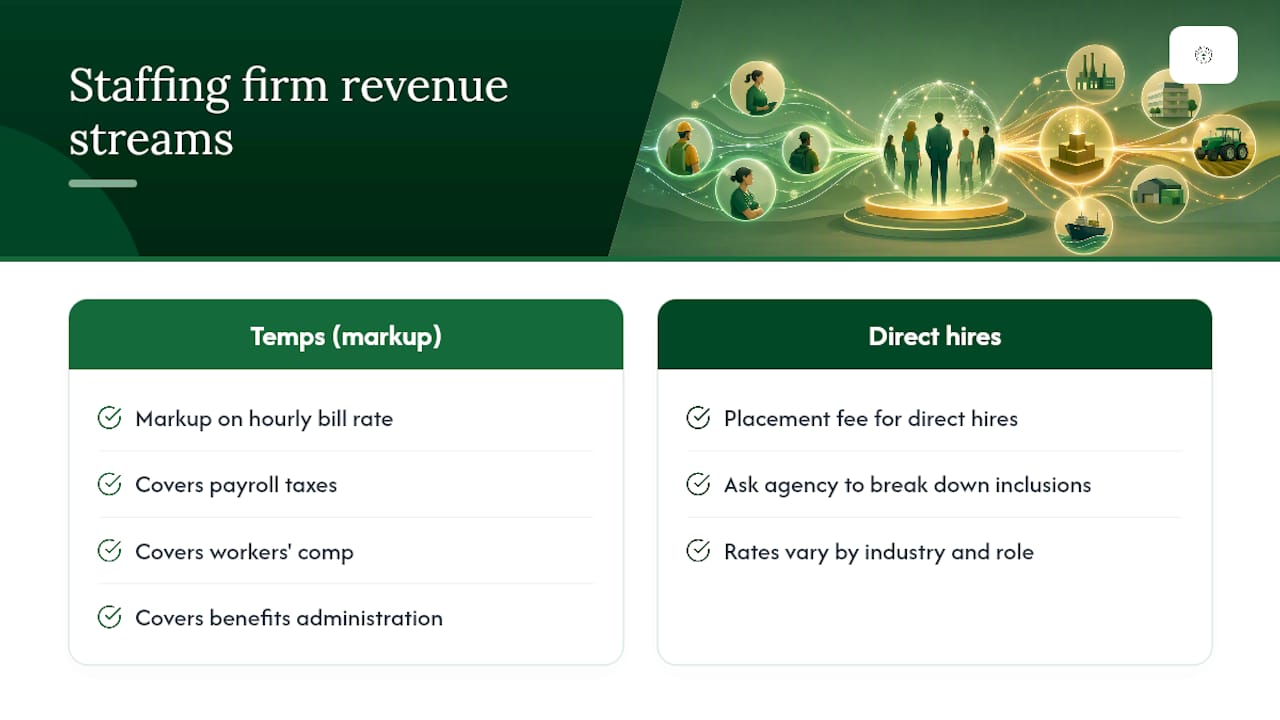
Rates vary by industry, role complexity, and local labor market conditions, so ask any agency to break down exactly what its markup or fee includes before signing.
How the Staffing Process Works Step by Step
For employers, the process typically runs through five stages:
- Intake and discovery: the agency asks why the role is open and what success looks like at 90 days, not just a job title match, an approach Kelly Services recommends specifically to improve fit
- Role definition: pay range, schedule, and required skills get locked down
- Sourcing and screening: the agency pulls from its candidate pool and runs initial interviews
- Onboarding: the worker starts under the agency's payroll and compliance systems
- Trial and conversion: for contract-to-hire, both sides evaluate fit before the worker moves to the client's payroll
Candidates move through a mirrored path: application, screening, placement, ongoing feedback, then possible conversion. Temp roles can start within days; direct hire and executive search often take several weeks to a few months.
Staffing Firm vs. Recruiter vs. In-House HR
These three roles get confused constantly, but they're not interchangeable. A staffing firm employs workers directly and handles their payroll, at least for temp and contract roles. A pure recruiting or placement firm typically just makes the introduction and steps away, with the client handling employment from day one. In-house HR manages the company's own permanent workforce and rarely touches temp payroll at all.
- Myth: "Staffing agencies only place entry-level workers." Fact: many run executive search and specialized technical placements
- Myth: "Candidates pay agency fees." Fact: the client business always pays
- If you're unsure who legally employs a worker on your site, ask the agency directly. Co-employment confusion causes real compliance headaches.
How to Choose the Right Staffing Firm
Not every agency operates at the same scale. Some are single-recruiter shops; others run full back-office operations with dedicated payroll and compliance teams, so verify actual capability rather than trusting a polished website alone.
- Ask how they handle intake: do they dig into role requirements and 90-day success metrics, or just match keywords?
- Confirm employer-of-record responsibilities in writing: who covers payroll, taxes, and workers' comp
- Get clear fee structures upfront, including any conversion or buyout costs for contract-to-hire
- Ask for local client references and proof of insurance
- Red flags: any agency charging candidates, vague fee language, or no verifiable references
Pro Tip: Define your conversion criteria for contract-to-hire before the assignment starts. Nail down the timeline, the performance bar, and who signs off, so nobody's surprised at month three.
Temporary Staffing or Contract-to-Hire: Which Fits Your Situation?
The decision usually comes down to two variables: how urgently you need someone, and how confident you are the role will last.
When urgency is high but demand certainty is low, temporary or contract staffing is the safer play. When both urgency and demand certainty are high, direct hire or a retained search makes more sense, according to guidance from City Staffing's Juliet Venturis.
For hiring managers, that means don't commit to a permanent salary line before you're sure the workload is permanent too.
Staffing Decisions Are Risk Decisions
Every staffing choice is really a bet on how certain your workforce needs are. Getting that bet right matters as much for a law firm managing seasonal filing surges as it does for a growing manufacturer, which is the kind of risk calculation Greatplainsnetworking helps small businesses make around their technology needs too.
Frequently Asked Questions
What is a staffing firm, in simple terms? A staffing firm is a company that recruits and places workers with client businesses, often acting as the legal employer for temporary and contract assignments while the client directs the daily work.
How is a staffing agency different from a recruiting firm? A staffing agency typically employs the worker directly for temp and contract roles, handling payroll and taxes. A recruiting firm usually just makes the match and steps back once the client hires the person directly.
Do candidates pay staffing firms a fee? No. The client business pays the agency's markup or placement fee. Any agency charging candidates a fee for placement is a warning sign worth walking away from.
How long does contract-to-hire typically last? Contract-to-hire arrangements usually include a trial period spanning several months before conversion, giving both the worker and the client time to confirm fit before the role becomes permanent.
What's the difference between temp staffing and direct hire? Temp staffing keeps the agency as employer of record with fast placement and no long-term commitment. Direct hire moves the worker onto the client's payroll immediately, with a slower process and a higher upfront fee.
Sources
- How do staffing agencies work — Kelly Services
- What Staffing Firms Do — American Staffing Association
- Types of staffing services — 4 Corner Resources
- Staffing agency glossary — Candidately