

Law firms are defined targets for cybercriminals because they store some of the most valuable confidential data on earth, including trade secrets, litigation strategies, financial records, and personally identifiable information for hundreds of clients, all within a single network. Cyberattacks on law firms increased by 77% in 2024, and one in five firms suffered a data breach in 2025. That rate matters because legal professionals are not just holding data. They are holding leverage. Understanding why law firms are cybercrime targets is the first step toward building a defense that actually works.
Why law firms are cybercrime targets: the data problem
Law firms are a one-stop shop for attackers because they aggregate privileged information from hundreds of clients into a single network. A breach at one firm can expose the confidential details of every client that firm has ever represented. That aggregation effect is what separates legal practices from most other small businesses.
The categories of data stored inside a typical law firm read like a wish list for a sophisticated attacker:
- Client financial records including account numbers, tax filings, and asset disclosures
- Personally identifiable information such as Social Security numbers, dates of birth, and passport data
- Litigation strategies and case evidence that could be sold to opposing parties
- Mergers and acquisitions intelligence with direct insider trading value
- Attorney-client privileged communications protected by law but highly sought after
- IOLTA and client trust account details that hold actual client funds
The last item deserves special attention. Business email compromise attacks targeting IOLTA accounts represent the highest financial cyber risk to law firms today. Attackers intercept wire transfer instructions and redirect funds before anyone notices. By the time the fraud is discovered, the money is gone.
Pro Tip: Verify every wire transfer instruction by calling the client or counterparty directly using a phone number on file, not one included in the email requesting the transfer.
Mergers and acquisitions data carries a separate risk. A firm advising on a pending acquisition holds non-public information that is worth real money on the open market. Attackers who steal that data can profit through illegal trading or sell it to competitors of the target company.

What attack methods do cybercriminals use against law firms?
74% of security breaches in the legal sector trace back to human error, including phishing, stolen credentials, and misuse of access privileges. That statistic points to a clear conclusion: the biggest vulnerability in most law firms is not the firewall. It is the people inside it.
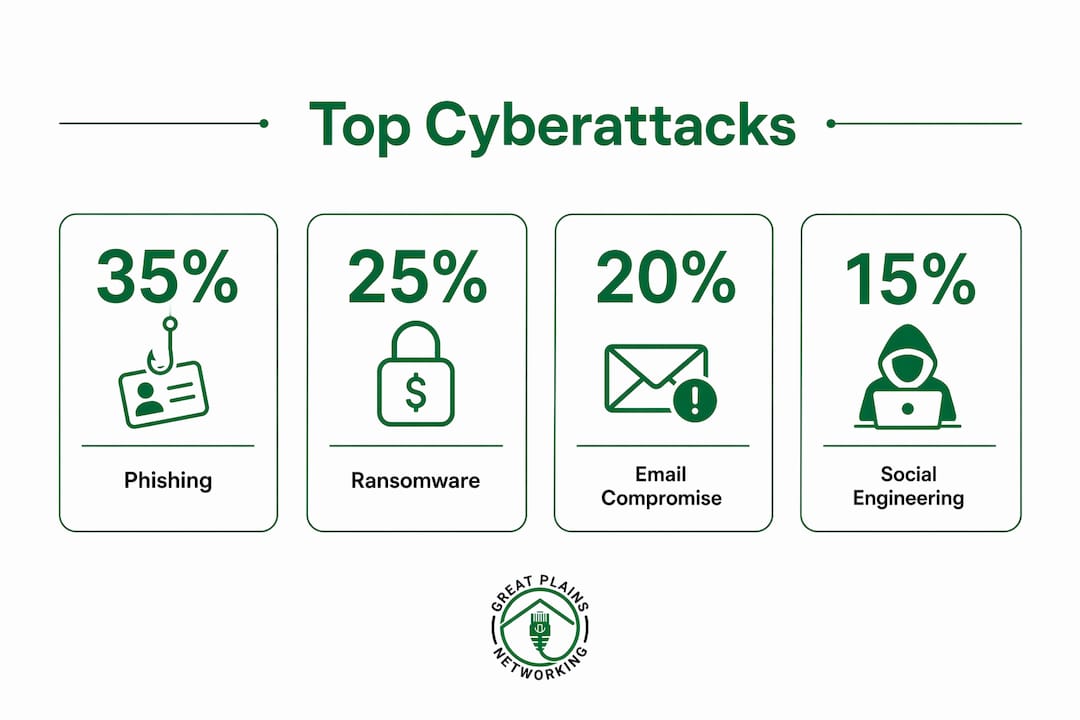
The most common attack methods targeting law firms in 2026 include:
- Phishing emails crafted to impersonate clients, courts, or opposing counsel, designed to steal login credentials or install malware
- Ransomware that encrypts client files and demands payment, often combined with data exfiltration to increase pressure
- Business email compromise that intercepts financial communications and redirects trust account transfers
- Social engineering including phone calls where attackers impersonate IT staff to extract passwords or remote access
- Credential stuffing using stolen username and password combinations purchased from dark web marketplaces
The Silent Ransom Group represents a particularly sophisticated threat. The FBI has warned that Silent Ransom Group uses both digital and physical attack methods against law firms, including in-person visits where operatives attempt to attach storage devices to firm computers. That dual approach combines a phishing call with a physical intrusion, maximizing the chance of success.
Attorney-client privilege creates a specific form of leverage that ransomware groups exploit deliberately. Privilege breach risks increase the likelihood that firms will pay ransoms rather than risk public disclosure of client communications. Attackers know this. They price their ransom demands accordingly.
A single compromised credential can grant extensive unauthorized access to client matters across an entire practice management system. Most legal software connects case files, billing records, and communications in one platform. One stolen password opens all of it.
Pro Tip: Enforce multi-factor authentication on every system that touches client data, including email, practice management software, and document storage. MFA blocks the majority of credential-based attacks.
How do ethical obligations shape law firm cybersecurity duties?
Cybersecurity is now a core professional obligation for attorneys, not an optional IT upgrade. 40 states have adopted a duty-of-technology-competence standard modeled after ABA Model Rule 1.6 and Comment 18. That standard requires attorneys to make reasonable efforts to prevent unauthorized disclosure of client information.
The practical implications of this ethical framework are significant:
- Firms that fail to implement reasonable cybersecurity safeguards face potential disciplinary action from state bar associations, even if no breach has occurred
- ABA Comment 18 specifically requires attorneys to consider the sensitivity of information, the likelihood of disclosure, and the cost of additional safeguards when designing security measures
- Cybersecurity obligations scale with firm size and case sensitivity. A firm handling national security litigation faces a higher standard than one handling residential real estate closings
- Governance must extend beyond the IT department. Firm leadership and partners must own cybersecurity decisions, not delegate them entirely to technical staff
- Incident response plans must assign clear roles at the partner level so that decision-making does not stall during an active breach
Good cybersecurity is now a professional and ethical duty. Firms face legal discipline for failing to maintain reasonable protection standards even if no breach occurs. That shifts cybersecurity from a cost center into a compliance requirement with real consequences.
The regulatory picture is also expanding. State attorneys general and bar associations are increasingly investigating firms after breaches to determine whether reasonable precautions were in place. A firm that cannot document its security practices is in a far weaker position than one with written policies, tested controls, and verified training records.
What practical steps reduce cybercrime risk for law firms?
Effective cybersecurity for law firms requires layered controls across people, processes, and technology. The table below compares the risk level and implementation priority for the most critical measures.
| Security measure | Risk addressed | Priority |
|---|---|---|
| Multi-factor authentication on all systems | Credential theft, unauthorized access | Immediate |
| Security awareness training (quarterly) | Phishing, social engineering, human error | High |
| Matter-level access controls | Lateral data exposure after breach | High |
| Encrypted email and file transfer | Interception of privileged communications | High |
| Documented incident response plan | Delayed or paralyzed breach response | High |
| Immutable offsite data backup | Ransomware, data destruction | High |
| Vendor and third-party due diligence | Supply chain attacks via software providers | Medium |
| 24/7 network monitoring | Undetected intrusions and data exfiltration | Medium |
Beyond the table, several practices deserve direct attention:
- Access controls at the matter level limit how far an attacker can move after compromising one account. If a paralegal's credentials are stolen, matter-level controls prevent the attacker from reading every client file in the system.
- Tested backup and recovery is the most reliable defense against ransomware. A firm with verified, offsite, immutable backups can restore operations without paying a ransom. Firms without tested backups face a choice between paying or losing data.
- Vendor due diligence matters because practice management platforms, e-discovery tools, and cloud storage providers all represent potential entry points. Firms should require vendors to document their own security controls and certifications.
- Incident response plans must be written, assigned, and rehearsed. Failing to involve firm leadership in cybersecurity governance leads to paralysis during incidents. Partners need to know their roles before an attack happens, not during one.
Engaging a managed IT provider that specializes in legal environments gives smaller firms access to enterprise-grade monitoring, incident response, and compliance support without the cost of a full internal security team. For firms in Norman, Moore, and Oklahoma City, that kind of localized, specialized support is available without long-term contracts.
Key takeaways
Law firms are cybercrime targets because they hold aggregated, high-value client data protected by privilege laws that attackers exploit to demand higher ransoms and avoid disclosure.
| Point | Details |
|---|---|
| Aggregated data creates outsized risk | A single breach exposes every client's confidential information stored across the firm's network. |
| Human error drives most breaches | 74% of legal sector breaches trace to phishing, stolen credentials, or misuse of access. |
| Privilege creates extortion leverage | Attackers demand higher ransoms knowing firms fear the reputational cost of disclosing breaches. |
| Ethics require documented security | 40 states mandate technology competence, and firms face discipline even without a confirmed breach. |
| Governance determines breach outcomes | Partners must own incident response roles. Delegating entirely to IT leads to paralysis under pressure. |
The uncomfortable truth about law firm cybersecurity
After working with law firms across Oklahoma on their IT and security posture, the pattern I see most often is not a technology gap. It is a mindset gap. Attorneys are trained to manage risk for their clients. They are rarely trained to manage risk for their own operations.
The firms that get hit hardest are not the ones with the worst firewalls. They are the ones where a senior partner assumes the IT person has it handled, and the IT person assumes the partners have approved a budget that does not actually exist. That gap in accountability is where attackers live.
The Silent Ransom Group's physical intrusion tactics are a good example of why this matters. No firewall stops someone who walks into your office and plugs a device into a workstation. Only trained staff, clear visitor protocols, and alert employees catch that kind of attack. Technology alone is never enough.
The firms I have seen recover fastest from incidents are the ones that treated cybersecurity as a governance issue before anything went wrong. They had written plans, tested backups, and partners who knew exactly what to do on day one of a breach. That preparation is not expensive. It is a decision. If your firm has not made that decision yet, the data on rising attack rates suggests the window for doing so comfortably is narrowing.
For a deeper look at how insurance intersects with these risks, the cybersecurity insurance guide for law firms is worth reviewing before your next renewal.
— Nicholas
How Greatplainsnetworking supports law firms against cyber threats
Law firms in Norman, Moore, and Oklahoma City face the same sophisticated threats as firms in major metro markets, but often without a dedicated internal security team to respond.

Greatplainsnetworking provides managed IT and cybersecurity services built specifically for small and midsize businesses, including law firms that handle sensitive client data every day. Services include 24/7 network monitoring, phishing-resistant email security, tested data backup and recovery, and incident response planning with clear partner-level roles. Greatplainsnetworking delivers all of this in plain language, with same-day response times and no long-term contracts. If your firm is ready to move from reactive to proactive, contact Greatplainsnetworking to schedule a security assessment.
FAQ
Why are law firms targeted more than other small businesses?
Law firms store aggregated confidential data from hundreds of clients in one network, making a single breach far more valuable to attackers than targeting individual businesses. Attorney-client privilege also creates extortion leverage that criminals exploit to demand higher ransoms.
What types of cyberattacks hit law firms most often?
Phishing, ransomware, business email compromise, and social engineering are the most common attack types targeting law firms. The FBI has specifically warned about Silent Ransom Group using both digital and physical methods against legal practices.
What is the duty of technology competence for attorneys?
The duty of technology competence requires attorneys to make reasonable efforts to protect client data from unauthorized disclosure. As of 2026, 40 states have adopted this standard based on ABA Model Rule 1.6 and Comment 18.
How can a law firm protect its IOLTA trust accounts from cybercrime?
Firms should enforce multi-factor authentication on all financial systems and verify every wire transfer instruction by phone using a number on file, never one provided in the requesting email. Business email compromise targeting trust accounts is the highest financial cyber risk law firms face today.
What is the fastest way to recover from a ransomware attack?
Verified, offsite, immutable backups are the fastest path to recovery without paying a ransom. Firms with tested backup and recovery plans restore operations in hours rather than days, and they do so without negotiating with attackers.