

Cybersecurity training for nonprofits is defined as a structured program that equips staff, volunteers, and leadership to recognize, resist, and report cyber threats targeting organizational data and systems. Nonprofits handle sensitive donor records, client health information, and financial data, making them high-value targets. Yet most operate with limited IT budgets and minimal dedicated security staff, a combination that creates serious exposure. Technical safeguards like MFA, email filters, and endpoint protection are necessary, but they cannot compensate for an untrained workforce. Understanding why nonprofits need cybersecurity training starts with acknowledging that people, not software, are the most exploited vulnerability in any organization.
Why nonprofits need cybersecurity training more than most organizations
Nonprofits occupy a uniquely difficult position in the cybersecurity world. They collect and store data that attackers find valuable, including donor payment details, client health records, and grant financials, yet they rarely have the resources to protect it at the level a corporation would. The 2026 CyberCAN Washington survey of 100 nonprofits found that the sector faces existential cybersecurity threats causing operational disruptions and financial losses. That finding signals a systemic gap, not an isolated problem.
Several factors make nonprofits especially attractive targets:
- Limited IT staffing. Many nonprofits rely on a single generalist IT contact or outsource support entirely, leaving security gaps unmonitored for extended periods.
- Volunteer involvement. Volunteers use personal devices, access shared accounts, and receive minimal security orientation, each of which introduces risk.
- Sensitive data concentration. Organizations serving healthcare, social services, or legal aid often hold data protected under HIPAA or state privacy laws.
- Trust-based culture. Nonprofit staff are trained to be helpful and responsive, which makes them more susceptible to social engineering and urgent-sounding requests.
- Underfunded security budgets. When resources are tight, cybersecurity spending is often deferred in favor of program delivery.
The broad operational impact of a breach extends beyond IT. Communications, finance, development, and leadership functions are all affected when donor trust erodes or systems go offline. A single successful phishing attack can freeze operations for days and permanently damage the relationships a nonprofit depends on for funding. For organizations in Norman, Moore, and Oklahoma City, where community trust is the foundation of every program, that risk is not abstract.
How training addresses the human side of cyber threats
The majority of successful cyberattacks begin not with sophisticated code, but with a person making a mistake. Phishing emails, malicious file attachments, and fake phone calls are the entry points attackers use most frequently. Training helps staff identify these threats early, slowing attacks and creating a culture of reporting rather than silence.

The mechanism is straightforward. Attackers exploit urgency, social pressure, and routine. A staff member who receives an email appearing to come from their executive director, asking for an urgent wire transfer, is likely to comply without questioning it unless they have been trained to pause and verify. That pause is what training creates. It does not require technical expertise. It requires a practiced habit of skepticism applied to specific, recognizable scenarios.
Here is how effective security awareness training builds that habit:
- Phishing simulations. Controlled fake phishing emails sent to staff measure click rates and identify who needs additional coaching. Organizations using consistent simulation training report measurable reductions in click rates and stronger leadership engagement with security.
- Role-based scenario modules. Finance staff learn to spot invoice fraud. Development staff learn to recognize fake grant portals. IT contacts learn escalation procedures. Generic training fails because it does not speak to the specific risks each role faces.
- Clear reporting procedures. Staff need to know exactly who to contact and how when they suspect a threat. Without a defined process, incidents go unreported and attackers gain more time.
- Volunteer and third-party inclusion. Training must extend beyond full-time employees. Volunteers and contractors who access systems or data carry the same risk as any staff member.
Pro Tip: Run a phishing simulation before launching formal training. The baseline click rate gives you a concrete starting point and helps leadership understand the real exposure level before any investment is made.
Training does not replace technical controls. MFA, email filtering, and endpoint protection remain necessary. But training complements these controls by closing the gap that technology cannot close: the moment when a person decides whether to click, share, or question.
What compliance requirements demand from nonprofit training programs
HIPAA is the most enforced compliance framework affecting nonprofits that handle health-related data, and it has explicit training requirements. Under 45 CFR §164.308(a)(5), covered entities and their business associates must implement a security awareness and training program for all workforce members, including management. Noncompliance carries significant financial penalties and audit exposure. This is not a best-practice recommendation. It is a legal mandate.
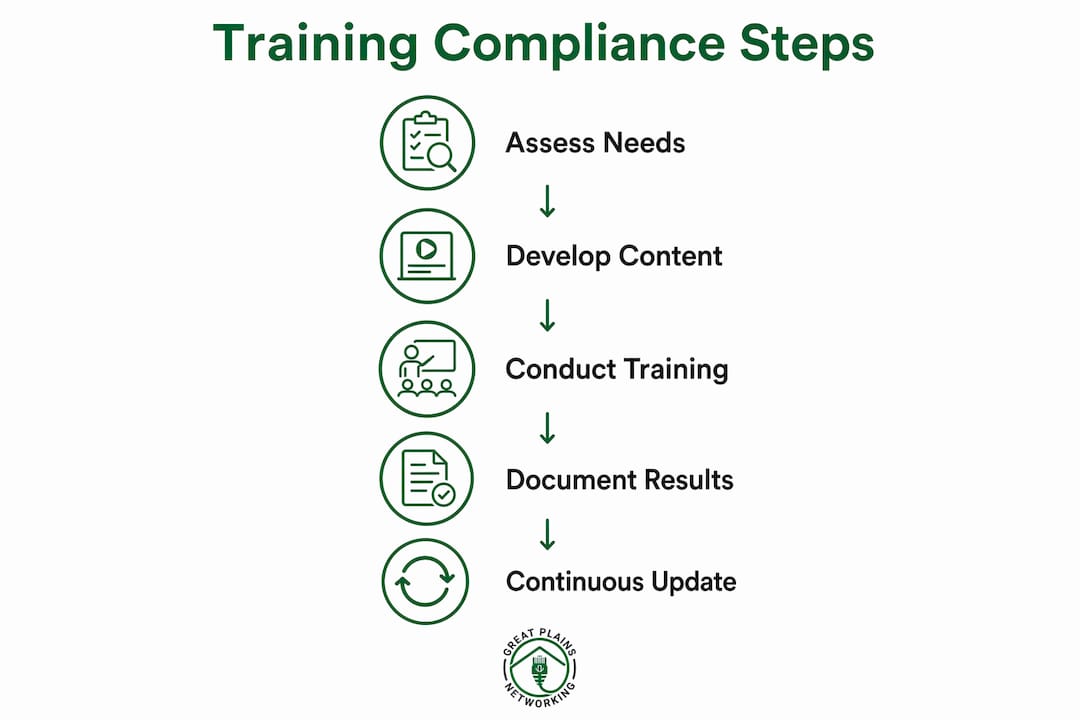
The specific implementation requirements under HIPAA include:
| Training Requirement | What It Covers |
|---|---|
| Security reminders | Periodic updates on current threats and policy changes |
| Malware protection | Procedures for guarding against and reporting malicious software |
| Log-in monitoring | Recognizing and reporting unauthorized access attempts |
| Password management | Creating, protecting, and updating credentials securely |
Each of these areas requires documented training, not just awareness. Auditors look for records showing that training occurred, who completed it, and when it was last updated. A nonprofit that delivers training verbally or through an informal email has no defensible record if a breach occurs and regulators investigate.
Beyond HIPAA, state-level data privacy laws increasingly require organizations to demonstrate that staff handling personal information have received security training. Oklahoma nonprofits working with federal grant programs may also face requirements tied to NIST SP 800-53, which specifies role-based training documentation and completion records as baseline controls.
Pro Tip: Keep a training log that records each staff member's name, the training completed, the date, and the version of the material used. This single document can significantly reduce audit risk and demonstrate good-faith compliance efforts.
Best practices for building effective cybersecurity training in nonprofits
Effective security awareness training is not a one-time video watched during onboarding. It is a continuous program that evolves with the threat environment and the organization's own risk profile. The RSM guidance on nonprofit cybersecurity is direct: the biggest failure in nonprofit security is not a lack of tools, but a lack of reinforcement.
Building a program that actually changes behavior requires the following:
- Start with a gap analysis. Assess what staff currently know, which roles carry the highest risk, and where past incidents or near-misses occurred. This shapes the training content rather than defaulting to generic modules.
- Use a recognized framework. NIST SP 800-53 and the NIST Cybersecurity Framework both provide structured guidance for building training programs that satisfy compliance requirements and address real-world risks.
- Deliver role-based content. A program director does not need the same training as a finance manager or a database administrator. Role- and risk-based training increases relevance and retention significantly.
- Schedule regular refreshers. Quarterly updates tied to current threats keep training relevant. Annual-only training is insufficient because the threat environment changes faster than a yearly cycle can track.
- Embed training into operations. Security reminders in staff meetings, brief scenario discussions during team check-ins, and leadership modeling of secure behavior all reinforce formal training without requiring additional budget.
- Measure outcomes. Track phishing simulation click rates, report submission rates, and training completion percentages over time. These metrics demonstrate program effectiveness and support budget requests.
- Document everything. Completion records, training materials, and update logs are the evidence that protects your organization during an audit or post-incident review.
For nonprofits exploring low-cost cybersecurity options, free and subsidized training resources are available through organizations like CISA and TechSoup. The investment in time to implement them correctly is far smaller than the cost of recovering from a breach.
Key takeaways
Nonprofits need cybersecurity training because human error is the primary attack vector, and training is the only control that directly addresses it across staff, volunteers, and leadership.
| Point | Details |
|---|---|
| Nonprofits are high-value targets | Sensitive donor and client data combined with limited IT resources creates serious exposure. |
| Training closes the human gap | Phishing simulations and role-based modules reduce click rates and build a reporting habit. |
| HIPAA mandates documented training | 45 CFR §164.308(a)(5) requires security awareness programs with records for all workforce members. |
| Reinforcement drives results | One-time training fails; quarterly refreshers embedded in operations produce lasting behavior change. |
| Documentation protects the organization | Training logs and completion records are the primary defense during audits and post-breach reviews. |
Why I think nonprofits underestimate the culture shift training requires
Working with nonprofits across Oklahoma, I have seen the same pattern repeat. Leadership approves a training video, staff complete it, and everyone assumes the box is checked. Six months later, someone clicks a phishing link and the organization scrambles. The problem is not that the training was bad. The problem is that it was treated as a one-time event rather than an ongoing commitment.
Cybersecurity training is a culture shift. It requires leaders to model secure behavior, not just mandate it. When an executive director asks staff to verify unusual requests before acting, and then does the same themselves, the message lands differently than any compliance module can deliver. I have seen consistent training programs produce measurable results in organizations with tight budgets, not because they spent more, but because they made security a visible, repeated priority. That is what separates organizations that recover quickly from those that do not.
— Nicholas
How Greatplainsnetworking helps nonprofits build real security
Greatplainsnetworking provides managed IT support tailored for nonprofits in Norman, Moore, and Oklahoma City, including cybersecurity services designed around the budget and staffing realities your organization actually faces.

The team at Greatplainsnetworking delivers MFA setup, email protection, endpoint security, and security awareness training as part of a coordinated program, not as disconnected add-ons. If your organization handles donor data, client health records, or federal grant funds, you need a verified, documented security posture. Greatplainsnetworking offers same-day response, no long-term contracts, and plain-language guidance that makes nonprofit IT support practical and sustainable. Contact the team today to discuss a security assessment built around your mission.
FAQ
What makes nonprofits a target for cyberattacks?
Nonprofits hold sensitive donor, client, and financial data while operating with limited IT staff and budgets, making them attractive and relatively easy targets. The CyberCAN Washington survey confirms that the sector faces existential cybersecurity threats with high incidence and low preparedness.
Does cybersecurity training replace technical controls like MFA?
No. Training complements technical controls by addressing human vulnerabilities that technology cannot prevent, such as an employee responding to a social engineering call. Both layers are required for an effective security posture.
Is cybersecurity training legally required for nonprofits?
Nonprofits that qualify as HIPAA covered entities or business associates are legally required under 45 CFR §164.308(a)(5) to implement a documented security awareness and training program for all workforce members. State privacy laws and federal grant requirements may impose additional obligations.
How often should nonprofit staff receive cybersecurity training?
Quarterly refreshers represent the minimum effective frequency, with phishing simulations run between formal sessions. Annual-only training does not keep pace with the evolving threat environment and leaves staff unprepared for current attack methods.
What should a nonprofit's training records include?
Training logs should document each staff member's name, the training module completed, the date of completion, and the version of the material used. These records are the primary evidence of compliance during audits and post-incident regulatory reviews.