

A nonprofit technology plan is a formal agreement that provides proactive, ongoing technology management and security oversight to protect mission-critical operations. Without one, your organization runs on reactive IT, meaning you fix problems only after they disrupt programs, staff, and donors. Why nonprofits need tech support plans comes down to three realities: limited budgets demand predictable costs, sensitive donor data requires active protection, and mission continuity cannot survive unplanned downtime. The gap between recognizing technology's importance and actually planning for it is wide. 74% of nonprofit leaders see technology as mission-critical, yet fewer than 33% have a documented technology strategy. That gap is where missions fail.
Why nonprofits need tech support plans to reduce downtime
Downtime is not just an IT inconvenience for nonprofits. It is a direct threat to donor trust, grant compliance, and program delivery. When your donor database goes offline during a fundraising campaign, or your case management system fails mid-service, the damage extends well beyond the technical fix.
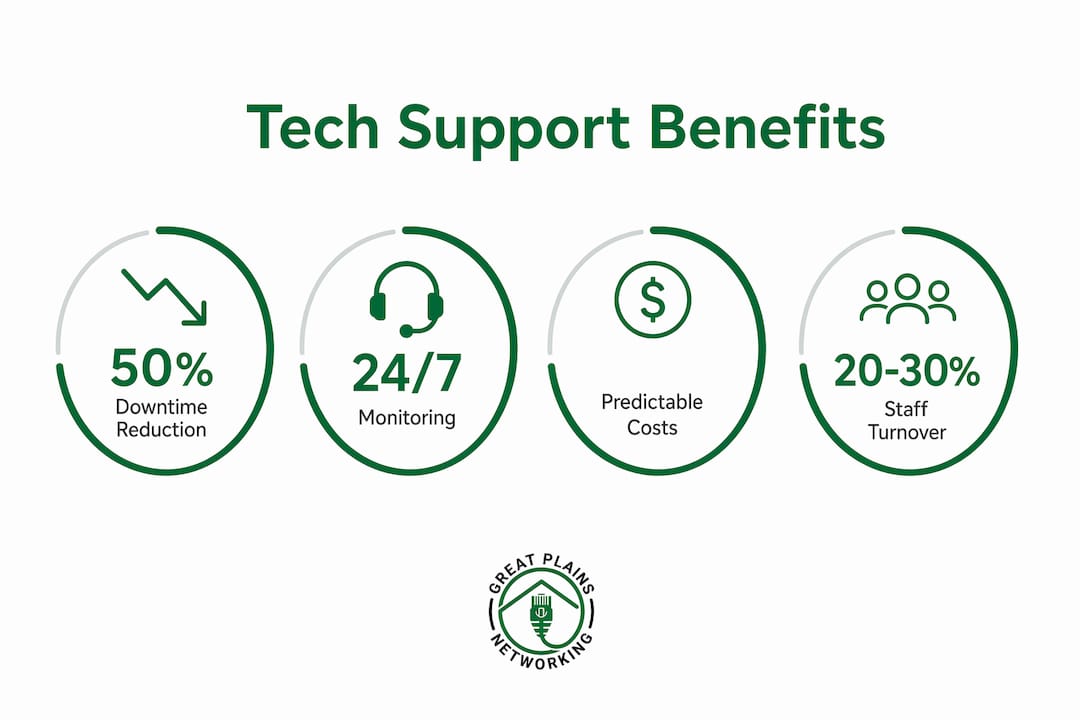
Managed IT services reduce nonprofit downtime by 50% compared to reactive, break-fix support models. That means organizations with proactive support plans spend half as much time offline as those without one. For a nonprofit running a food bank, a shelter intake system, or a donor portal, that difference is measurable in people served.
Proactive tech support plans include three core protections:
- 24/7 monitoring: Systems are watched continuously, so problems are caught before they cause outages.
- Patch management: Software and security updates are applied on schedule, closing vulnerabilities before attackers find them.
- Helpdesk access: Staff get fast answers without waiting days for a volunteer IT contact to respond.
"Technology risk is inseparable from financial risk for nonprofits. Cybersecurity incidents can lead to financial penalties, loss of funding, and operational interruptions that directly undermine the mission." Fairlight Advisors
Donor trust erodes quickly after a data breach or a visible system failure. Funders and grant-making bodies increasingly ask about IT security practices before awarding grants. A documented, active tech support plan is evidence that your organization takes data stewardship seriously.
What technology challenges do nonprofits face without support plans?
Nonprofits operate with structural IT disadvantages that make unplanned technology management especially dangerous. Understanding these gaps is the first step toward closing them.

Under-investment in IT budgets
Most nonprofits spend less than 2% of revenue on IT, despite industry benchmarks recommending 4–6%. That shortfall leaves systems unpatched, hardware outdated, and staff without adequate tools. The result is not just inefficiency. It is compounding risk that grows with every year of deferred investment.
High staff turnover and security gaps
Nonprofit staff turnover runs at 20–30% annually. Each departure creates a potential security vulnerability if accounts are not deactivated promptly and access is not revoked. Orphaned accounts, shared passwords, and undocumented system access are common in organizations without formal IT processes. Routine access controls and documented offboarding are the direct remedy, but they require a managed IT partner to enforce consistently.
The table below shows how common nonprofit IT gaps compare in risk level and typical resolution:
| IT Gap | Risk Level | Resolution |
|---|---|---|
| No offboarding process | High | Documented access revocation policy |
| Shadow IT and unlicensed tools | Medium | Tech stack audit and inventory |
| Outdated or unpatched software | High | Scheduled patch management |
| No IT budget line item | High | Fixed monthly managed IT plan |
| Undocumented systems and processes | Medium | Lightweight technology inventory |
Patchwork systems and shadow IT
Many nonprofits accumulate software tools over years of grant-funded projects. Each program may use different platforms, few of which communicate with each other. Staff fill gaps with personal tools or free apps, creating shadow IT: technology in active use that no one officially manages or secures. Tech stack audits reveal hidden redundancies, overlapping software, and unsupported tools that inflate costs and complicate any future support arrangement.
The strategy gap is equally telling. Despite most nonprofit leaders acknowledging technology's role in mission delivery, fewer than one in three organizations has a written technology plan. That means the majority are making IT decisions reactively, without a framework for prioritization or investment.
Should nonprofits treat tech support plans as strategic investments?
The answer is yes, and the financial case is straightforward. Reactive IT support generates unpredictable costs. Emergency repairs, data recovery after a breach, and rushed hardware replacements all arrive without warning and without budget. A tech support plan converts those unpredictable costs into a fixed monthly expense.
Fixed monthly IT support costs provide the predictability that benefits grant reporting and aligns spending with organizational capacity. Grant budgets require line-item justification. A fixed managed IT fee is far easier to document and defend than a series of emergency invoices.
Pro Tip: When writing your next grant budget, include your managed IT support fee as a direct operational cost. Many funders accept technology infrastructure as a legitimate program expense, especially when you can show it protects donor data and program continuity.
Treating technology as a strategic enabler rather than a cost burden changes how your board and finance committee evaluate IT requests. Instead of asking "Can we afford this?", the question becomes "What does it cost us not to have this?" The answer, measured in downtime, data loss, and donor attrition, is almost always higher than the support plan itself.
A tech support plan also creates the foundation for a technology roadmap. With a managed IT partner, your organization can plan hardware refresh cycles, software migrations, and security upgrades on a schedule that aligns with your funding cycles rather than reacting to failures.
How can nonprofits build and use effective tech support plans?
Building a tech support plan starts with knowing what you have. Most nonprofits are surprised by what a structured audit uncovers.
-
Conduct a technology audit. A nonprofit tech stack audit typically takes 2–4 weeks and identifies unused licenses, shadow IT, and processes that have outlived their usefulness. The audit output becomes your baseline inventory.
-
Map your technology to your mission. Lightweight enterprise architecture methods help nonprofits connect their technology, processes, and data to organizational goals. Small-scope engagements in this area cost $3,000–$15,000 and produce a roadmap that aligns IT spending with mission capacity.
-
Document onboarding and offboarding. Every staff member and volunteer who accesses your systems needs a documented process for gaining and losing that access. This single step closes the most common security gap created by high turnover.
-
Choose a managed IT provider with nonprofit experience. Generic IT support does not account for grant reporting requirements, volunteer access management, or the budget constraints nonprofits face. A provider familiar with local nonprofit IT support understands these realities and builds plans around them.
-
Set a realistic IT budget and review it annually. Moving from under 2% of revenue toward the 4–6% benchmark does not have to happen in one year. A managed IT partner can help you prioritize the highest-risk gaps first and build toward a full plan over time. Reviewing your IT budgeting practices annually keeps spending aligned with organizational growth and risk.
The comparison below shows how reactive IT support and a managed tech support plan differ in practice:
| Factor | Reactive IT only | Managed tech support plan |
|---|---|---|
| Cost structure | Variable, unpredictable | Fixed monthly fee |
| Issue detection | After failure occurs | Before failure occurs |
| Security patching | Ad hoc or delayed | Scheduled and documented |
| Staff onboarding/offboarding | Inconsistent | Standardized process |
| Grant budget alignment | Difficult to justify | Clear line-item expense |
The most effective approach is to start with the audit, address the highest-risk gaps immediately, and build the rest of the plan around a fixed-cost managed IT relationship.
Key Takeaways
Nonprofits that operate without a documented tech support plan accept compounding operational and security risks that directly threaten mission delivery and donor trust.
| Point | Details |
|---|---|
| Downtime cuts mission capacity | Managed IT reduces downtime by 50%, protecting programs and donor relationships. |
| IT under-investment is a security risk | Most nonprofits spend under 2% of revenue on IT, well below the 4–6% benchmark. |
| Staff turnover creates access vulnerabilities | Documented onboarding and offboarding processes close the most common security gap. |
| Fixed costs simplify grant reporting | A monthly managed IT fee is easier to budget and justify to funders than emergency expenses. |
| Audits reveal hidden waste | A tech stack audit uncovers shadow IT, redundant licenses, and unsupported tools in 2–4 weeks. |
Why I think most nonprofits are one incident away from a serious problem
I have worked with enough small organizations to recognize a pattern. The executive director knows technology matters. The board agrees in principle. But when budget season arrives, IT gets cut first because it feels abstract until something breaks.
The data confirms what I see in practice. Nearly three quarters of nonprofit leaders call technology mission-critical, yet two thirds have no written plan for managing it. That is not a knowledge gap. It is an execution gap, and it is exactly where crises originate.
The organizations that recover fastest from ransomware, data loss, or system failures are not the ones with the biggest budgets. They are the ones with documented processes, a managed IT partner who already knows their systems, and a support plan that was in place before anything went wrong. Intention without execution is just risk with a friendly name.
If your organization has not reviewed its technology setup in the past 12 months, that review is overdue. Start with an audit. Find a provider who speaks plainly, charges a fixed monthly fee, and understands what a nonprofit actually needs. The cost of a support plan is predictable. The cost of not having one is not.
— Nicholas
How Greatplainsnetworking supports nonprofits with managed IT
Nonprofits in Norman, Moore, and Oklahoma City have a local option for building a tech support plan that fits their budget and mission.
Greatplainsnetworking provides managed IT support with fixed monthly pricing, 24/7 monitoring, and same-day response times. There are no long-term contracts, which means your organization is not locked in if your needs change. Services include cybersecurity protection and backup and recovery designed to protect donor data and keep programs running after an incident. Greatplainsnetworking works in plain language, without technical jargon, so your leadership team always understands what is covered and why. Contact Greatplainsnetworking to schedule a technology review for your nonprofit.
FAQ
What is a nonprofit technology plan?
A nonprofit technology plan is a documented strategy that defines how an organization manages, secures, and funds its IT systems to support mission delivery. It typically includes a technology inventory, budget allocation, security policies, and a roadmap for future upgrades.
How much should a nonprofit spend on IT?
Industry benchmarks recommend nonprofits spend 4–6% of annual revenue on IT. Most currently spend less than 2%, which creates significant security and operational risk.
How do tech support plans protect donor data?
Tech support plans include scheduled security patching, access controls, and 24/7 monitoring that prevent unauthorized access to donor databases and financial records. These measures also reduce the risk of breaches that could trigger regulatory penalties or loss of donor confidence.
What is the difference between reactive IT and managed IT support?
Reactive IT fixes problems after they occur, generating unpredictable costs and extended downtime. Managed IT support monitors systems continuously, addresses issues before they escalate, and provides a fixed monthly cost that is easier to budget and justify to funders.
How does staff turnover affect nonprofit IT security?
Nonprofit staff turnover of 20–30% annually creates orphaned accounts and undocumented system access that attackers can exploit. Documented onboarding and offboarding processes, enforced by a managed IT provider, close these vulnerabilities consistently.