
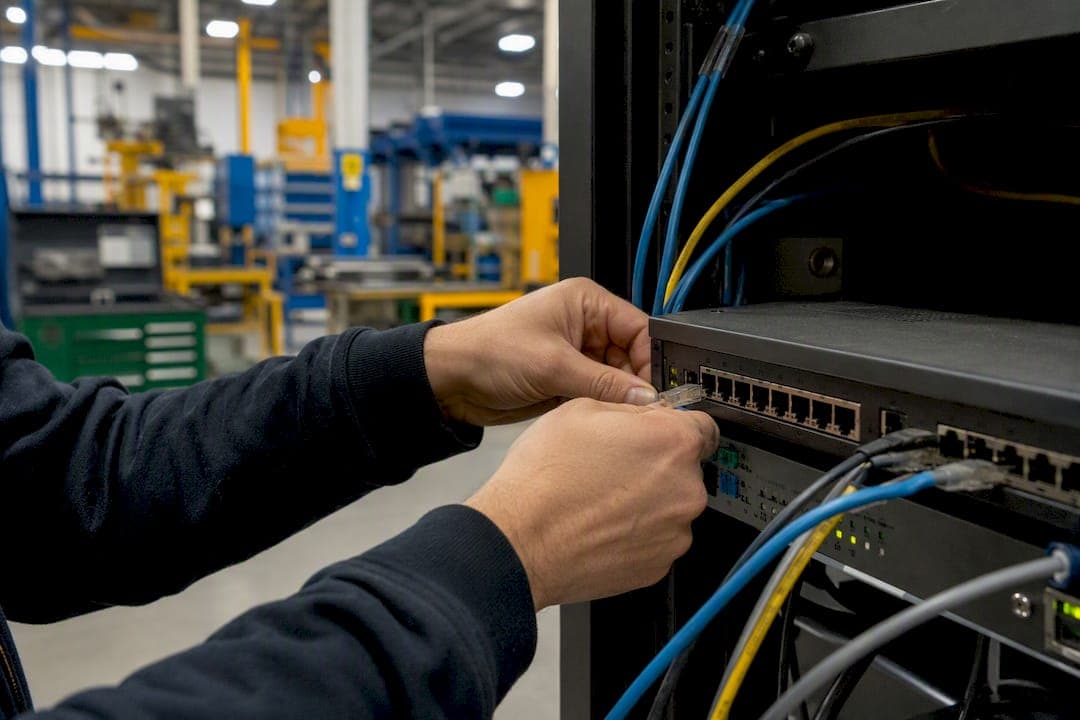
Manufacturers face outsized ransomware risk because attackers can turn a single production stoppage into fast, oversized leverage. Downtime on a factory floor costs money by the minute, and the wall between IT and OT networks is often thinner than plant managers assume. Add valuable intellectual property and sprawling supplier networks, and you get a sector attackers return to again and again: Bitsight's leak-site tracking puts manufacturing's share of observed ransomware attacks at 27.1%, the largest of any industry. Sophos found that exploited vulnerabilities caused 32% of manufacturing incidents in 2025. Greatplainsnetworking sees the same pattern play out for smaller regional manufacturers that assumed they were too small to matter.
Start this week with three moves:
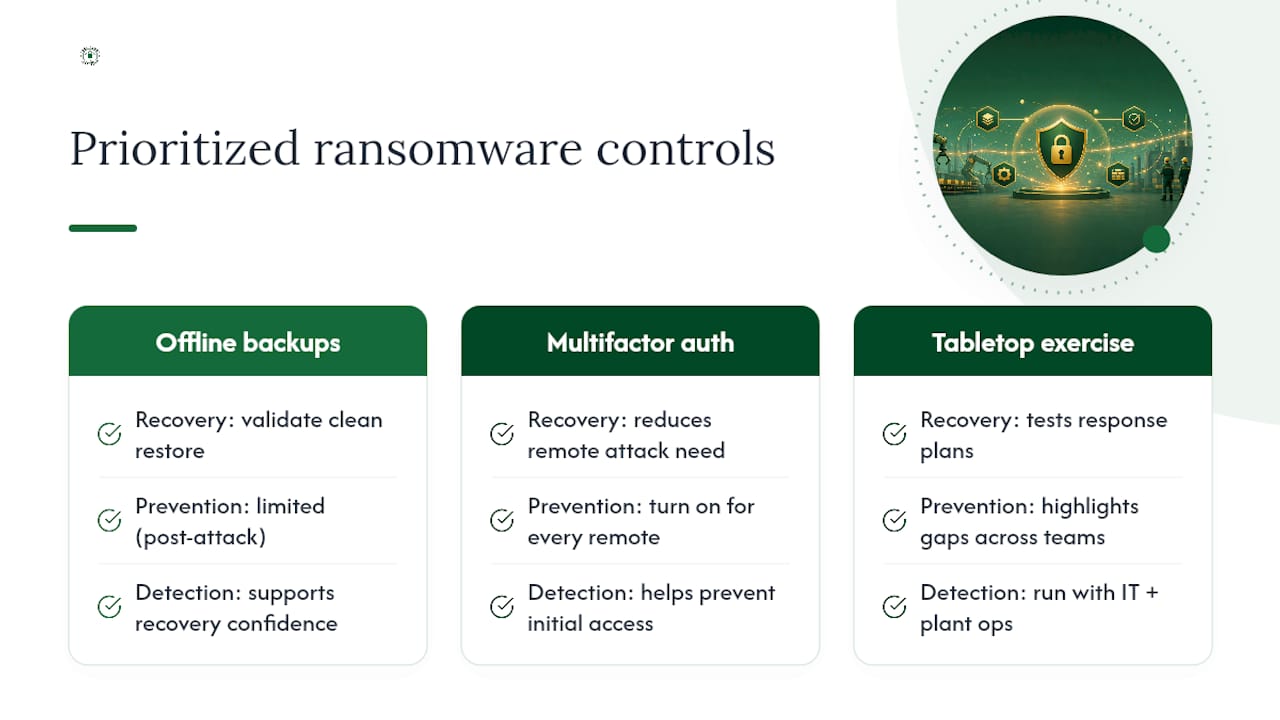
- Confirm your backups are offline, immutable, and actually restorable.
- Turn on multi-factor authentication for every remote access point, including vendor accounts.
- Review which third-party vendors can reach your OT network, and why.
Key Takeaways
Manufacturers face elevated ransomware risk because attackers convert operational downtime, weak IT/OT boundaries, and valuable intellectual property into fast payment pressure.
| Point | Details |
|---|---|
| Manufacturing leads attack share | Manufacturing accounted for 27.1% of tracked ransomware leak-site posts, the highest of any sector. |
| Vulnerabilities are the top cause | Exploited, unpatched software caused 32% of manufacturing ransomware incidents in 2025. |
| Extortion-only attacks are rising | Data theft without encryption climbed to 10% of incidents, requiring separate leak-site monitoring. |
| Segmentation beats broad EDR | Purdue-based IT/OT segmentation and jump hosts reduce attacker lateral movement more than endpoint tools alone. |
| Managed monitoring shortens response | Greatplainsnetworking's 24/7 monitoring, backup validation, and vendor access review target the exact gaps attackers exploit. |
Table of Contents
- Why Manufacturers Face Ransomware Risks: The Numbers Behind the Trend
- Why Manufacturers Are Attractive Ransomware Targets
- Common Entry Points Attackers Exploit in Manufacturing Networks
- How an IT Breach Turns Into an OT Shutdown
- The Real Cost of Ransomware for Manufacturers
- Prioritized Controls That Actually Reduce Ransomware Risk
- Why OT Incident Response Looks Different From IT Incident Response
- How Managed IT Support Fits Into a Manufacturer's Defense
- What Manufacturers Get Wrong About Their Own Risk
- Get Your Manufacturing Ransomware Risk Assessed
- Frequently Asked Questions
- Sources
Why Manufacturers Face Ransomware Risks: The Numbers Behind the Trend
The statistics tell a consistent story: manufacturing isn't an occasional target, it's the preferred one. Verizon's 2026 DBIR manufacturing snapshot identifies exploited vulnerabilities and rising third-party involvement as the two biggest drivers of breaches in the sector. Dragos, which tracks industrial ransomware specifically, has documented a growing roster of threat groups that pivot from IT compromise straight into operational technology.
By the numbers: Exploited vulnerabilities caused 32% of manufacturing ransomware incidents, extortion-only attacks (data theft without encryption) rose to 10% in 2025, and manufacturing led all sectors with 27.1% of tracked leak-site posts.
That extortion-only shift matters more than it sounds. Attackers increasingly skip encryption altogether and just threaten to leak stolen designs or customer data, which sidesteps a company's backup strategy entirely.
- Manufacturing accounts for the largest share of ransomware leak-site victims of any industry tracked.
- Extortion-only attacks, which rely purely on data theft, are climbing as a share of total incidents.
- Multiple distinct threat groups now specialize in industrial targets rather than opportunistic hits.
Why Manufacturers Are Attractive Ransomware Targets
Attackers choose targets based on leverage, and manufacturing offers more of it than almost any other sector. Just-in-time production schedules mean a single stopped line can cost thousands of dollars per minute, and that math pushes companies toward paying fast rather than negotiating slowly. MxD's analysis of ransomware economics makes the point directly: downtime, not the ransom demand itself, is the real weapon.
Several structural factors compound that pressure:
- Proprietary formulas, CAD files, and process documentation give attackers extortion material beyond simple encryption.
- Dense supplier networks mean one vendor's outage can stall assembly lines at multiple companies simultaneously.
- Regulatory and safety obligations, especially in food, pharma, and defense supply chains, add urgency that pure IT breaches rarely carry.
- FBI case reporting shows both criminal and state-linked actors have targeted manufacturers specifically for intellectual property, not just quick payouts.
Common Entry Points Attackers Exploit in Manufacturing Networks
Most manufacturing breaches don't start with anything exotic. They start with the same handful of openings attackers have used for years, left unpatched a little too long.
- Exploited public-facing services. Unpatched RDP, VPN appliances, and exposed SMB shares remain the single largest root cause, responsible for 32% of manufacturing incidents.
- Phishing and stolen credentials. Malicious email continues to be a top entry vector, often targeting plant administrators who have broad system access.
- Third-party and vendor compromise. Verizon's data shows third-party involvement in manufacturing breaches is climbing, frequently through remote monitoring tools installed by equipment vendors.
- Legacy systems and weak account hygiene. Older Windows machines on the plant floor, unmanaged service accounts, and inconsistent MFA coverage give attackers room to move once they're inside.
How an IT Breach Turns Into an OT Shutdown
The jump from "someone clicked a phishing link" to "the line is down" follows a fairly predictable path. Attackers land in the corporate IT environment first, then look for a way across the IT/OT boundary using tools that look like normal administrator activity: RDP sessions, SMB file transfers, PsExec, WinRM, and WMI. None of this requires industrial protocol knowledge.
The real prize is usually the virtualization layer. Dragos has documented attackers targeting VMware ESXi hosts and historian servers specifically, because encrypting a single hypervisor can take down dozens of virtual machines at once. That's a faster route to operational chaos than attacking individual PLCs.
- Initial foothold in IT, often via phishing or an exposed remote-access service.
- Lateral movement using standard admin protocols, not ICS-specific malware.
- Targeting of ESXi hosts, historians, and engineering workstations to maximize blast radius.
- Backup destruction and data exfiltration before the final encryption or extortion trigger.
Pro Tip: Log every RDP, WinRM, and PsExec session that crosses the IT/OT boundary, even ones that look routine. That log is often the only early warning you'll get before a hypervisor goes dark.
The Real Cost of Ransomware for Manufacturers
Ransom payments are rarely the biggest expense. The bigger number is downtime, and it compounds fast when a single stopped line ripples out to every supplier and customer contract tied to it.
Manufacturers absorb costs on multiple fronts at once: lost production during the outage, contractual penalties for late shipments, and the long tail of reputational damage if stolen IP or customer data surfaces later.
Security teams often take the hardest internal hit. Leadership pressure spikes the moment production stops, and IT staff who were already stretched thin end up managing recovery, vendor calls, and executive updates simultaneously. That's one reason downtime reduction deserves as much planning attention as the ransom scenario itself.
Prioritized Controls That Actually Reduce Ransomware Risk
Not every control matters equally, and manufacturers with limited security budgets need to know where to spend first. The list below runs roughly in order of impact.
- Segment IT from OT using Purdue-model boundaries. Block SMB traffic across that boundary entirely, and route any necessary access through dedicated jump hosts rather than direct connections.
- Keep OT backups offline and immutable. If backups live on the same network attackers can reach, they'll destroy them before triggering encryption. Verified, tested backups are the difference between a bad day and a bad month.
- Enforce MFA everywhere, including vendor remote access. Privileged access workstations and rotated service-account credentials close off the easiest lateral-movement paths.
- Deploy passive, OT-aware monitoring. Traditional SIEM tools miss abnormal engineering-session behavior; you need visibility built for industrial protocols, not just IT traffic.
- Record and control vendor sessions. Third-party access is a documented breach vector, so session recording and time-limited credentials matter as much as your own staff's access controls.
- Run joint IT/OT tabletop exercises. Align vulnerability-management schedules with maintenance windows so patching doesn't get pushed off indefinitely.
Dragos and other practitioners consistently rank architectural controls like segmentation and jump hosts above broad endpoint tools for OT protection, largely because OT environments can't tolerate the same aggressive detection responses IT networks can. For a deeper look at how these controls fit together on a manufacturing network, network management best practices built for production environments cover the architecture side in more depth.
Pro Tip: If you can only fund one control this quarter, fund immutable offline backups for OT-critical systems. Everything else buys time; backups buy recovery.

Why OT Incident Response Looks Different From IT Incident Response
Standard IT incident response often means isolating a compromised host immediately. On a plant floor, that same move can shut down a process mid-run, which creates its own safety risk. OT-aware response teams have to weigh attacker removal against maintaining a safe process state, which is a tradeoff IT security rarely has to make.
Detection signals worth watching for include:
- Unexpected protocol flows between segments that normally don't talk to each other.
- New or unrecognized devices appearing on the OT network.
- Abnormal engineering-session behavior, like configuration changes outside a scheduled maintenance window.
Comprehensive OT visibility makes a measurable difference here: organizations with mature OT monitoring contain incidents in roughly 5 days on average, compared to industry-wide averages closer to 42 days. That gap comes down to practiced runbooks and session recording that let responders reconstruct what happened without guessing. Regular tabletop exercises, especially ones that test historian and HMI recovery specifically, are what turn a documented plan into a team that actually knows what to do at 2 a.m.
How Managed IT Support Fits Into a Manufacturer's Defense
Smaller manufacturers rarely have a dedicated OT security team, which is exactly the gap Greatplainsnetworking's approach is built to close for regional shops. Twenty-four seven monitoring shortens detection windows before a foothold turns into a shutdown. Backup validation confirms recovery actually works instead of assuming it does. Cybersecurity assessments surface unpatched exposures before attackers find them, and vendor access controls close off the third-party paths that keep showing up in breach reports.
Before you rely on any internal team or outside provider, ask them: How fast do you detect anomalies? When did you last test our backup restore? Who reviews vendor remote access?

What Manufacturers Get Wrong About Their Own Risk
Most manufacturing leaders still think of ransomware as an IT problem that occasionally spills onto the plant floor. It's the reverse. The plant floor's economics are what make manufacturers worth targeting in the first place, and until that framing shifts inside leadership meetings, budget will keep flowing toward generic IT security instead of the OT-specific controls that actually reduce exposure. This week, validate that your offline backups restore cleanly, turn on MFA for every remote connection, and run one tabletop exercise that includes both IT and plant operations staff in the room together. If you're not confident in how quickly your team would detect a breach today, that's worth an honest audit before it becomes an expensive lesson.
Get Your Manufacturing Ransomware Risk Assessed
A do-it-yourself security review catches some gaps, but most small manufacturers don't have the spare hours to map their own IT/OT boundary, test backup restores, and audit vendor access all at once. Greatplainsnetworking handles that work directly for manufacturers in Norman, Moore, and Oklahoma City, combining 24/7 monitoring with the same segmentation and backup priorities covered above.
The fit is straightforward: managed IT support covers ongoing detection, cybersecurity assessments identify exposed vulnerabilities before attackers do, and backup and recovery services confirm your restore process actually works when you need it. There's no long-term contract required to start, and response times are same-day. Request a backup validation check or a cybersecurity assessment this week to see exactly where your plant's IT/OT boundary stands today.
Frequently Asked Questions
Why are manufacturers targeted by hackers more than other industries? Manufacturers combine three things attackers want: production that can't tolerate downtime, valuable intellectual property, and supply chains where one company's outage disrupts several others. That combination creates faster, larger payment pressure than most other sectors offer.
What is the most common way ransomware enters a manufacturing network? Exploited, unpatched public-facing services, including RDP, VPN appliances, and exposed SMB shares, remain the leading cause, with phishing and stolen credentials close behind.
How does ransomware move from IT systems into OT and plant floor equipment? Attackers use standard administrative tools like RDP, PsExec, and WinRM to move laterally, often targeting VMware ESXi hypervisors and historian servers because compromising them affects many systems at once without needing industrial-specific malware.
What's the single most effective mitigation for manufacturers? Immutable, offline backups for OT-critical systems, paired with strict IT/OT network segmentation, address the two failure points attackers rely on most: destroying recovery options and moving freely between networks.
How is incident response different for OT environments compared to standard IT breaches? OT response has to balance removing an attacker against maintaining a safe process state, since isolating a host abruptly can interrupt a running process in ways that create physical safety risks, not just data loss.
Sources
- The State of Ransomware in Manufacturing and Production 2025 | Sophos
- Dragos industrial ransomware analysis Q2 2026
- 2026 DBIR manufacturing snapshot | Verizon
- 2026 Ransomware Statistics & Deep Web Threat Trends: Bitsight